

The End of the Generalist Marketing Era
Why are generalist marketers disappearing in 2026? Because automation has successfully commoditized the "middle" layer of marketing execution. In the 2026 marketing arena, being "average at everything" is no longer a viable career path; it is redundant.
This topic matters because professionals who do not pivot to specialist marketing skills risk being replaced by AI agents that are faster, cheaper, and more accurate. The future of digital marketing belongs to those who can architect a strategy rather than just execute tasks.
Current marketing trends 2026 indicate that the market now values deep vertical expertise over broad horizontal knowledge.
Definition: A Generalist Marketer is a professional who handles a wide range of tasks, such as copywriting, social media scheduling, and basic analytics, without possessing elite-level technical skills in any single area.
This topic matters because professionals who do not pivot to specialist marketing skills risk being replaced by AI agents that are faster, cheaper, and more accurate. The future of digital marketing belongs to those who can architect a strategy rather than just execute tasks.
Current marketing trends 2026 indicate that the market now values deep vertical expertise over broad horizontal knowledge.
Definition: A Generalist Marketer is a professional who handles a wide range of tasks, such as copywriting, social media scheduling, and basic analytics, without possessing elite-level technical skills in any single area.
Reason 1: Agentic AI Has Taken Over Execution
The first reason the generalist marketing is disappearing is the rise of Agentic AI. Generalists used to be paid to "do" things; now, AI agents do them.
We have moved beyond "Generative AI" (text creation) to "Agentic AI" (workflow execution). AI marketing strategies now involve deploying autonomous agents to plan, launch, and optimize campaigns without human intervention.
Real-World Context:
According to Gartner, by 2028, at least 15% of day-to-day work decisions will be made autonomously through agentic AI. Furthermore, 33% of enterprise software applications will include agentic AI.
Generalist Marketers Role: Manually logging into Meta Ads Manager to tweak bids and swap creative.
AI Reality: An autonomous agent monitors 5,000 ad variations in real-time, killing losing ads and scaling winners within seconds, 24/7.
In simple terms, the human role has shifted from "operator" to "governor." Generalists often lack the technical depth to audit these complex systems.
We have moved beyond "Generative AI" (text creation) to "Agentic AI" (workflow execution). AI marketing strategies now involve deploying autonomous agents to plan, launch, and optimize campaigns without human intervention.
Real-World Context:
According to Gartner, by 2028, at least 15% of day-to-day work decisions will be made autonomously through agentic AI. Furthermore, 33% of enterprise software applications will include agentic AI.
Generalist Marketers Role: Manually logging into Meta Ads Manager to tweak bids and swap creative.
AI Reality: An autonomous agent monitors 5,000 ad variations in real-time, killing losing ads and scaling winners within seconds, 24/7.
In simple terms, the human role has shifted from "operator" to "governor." Generalists often lack the technical depth to audit these complex systems.
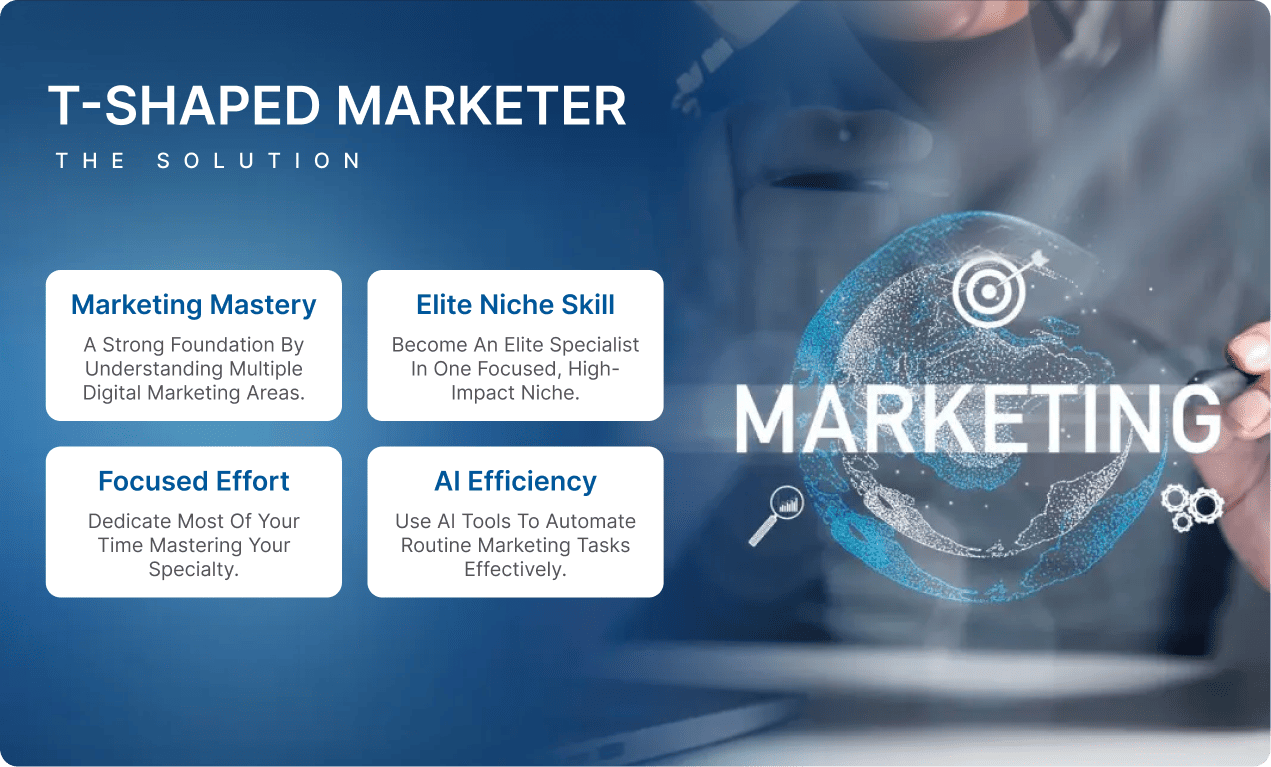
Reason 2: GEO Makes Generalist Marketer's Content Invisible
Marketing trends for 2026 indicate a significant decline in organic clicks due to Google's AI Overviews. This shift to GEO (Generative Engine Optimization) is killing the generalist writer.
Generalists who write standard "10 Tips" blog posts are invisible in this new world because AI answers simply summarize that info without clicking through.
Generalists who write standard "10 Tips" blog posts are invisible in this new world because AI answers simply summarize that info without clicking through.
The Specialist Pivot: Information Gain
To win in GEO, you must provide "Information Gain," data or insights that the AI model does not already possess.
Reason 3: The "Trust Gap" Rejects Generic Content
As the internet floods with AI-generated content, content marketing trends 2026 have pivoted entirely to "Human Trust."
A generalist marketers often creates "voice-of-the-brand" content that feels neutral and corporate. In 2026, neutrality is ignored.
The POV Shift:
Audiences demand "Point of View" (POV) content from real Subject Matter Experts (SMEs).
Content marketing trends 2026 favor raw, unpolished video over stock photos.
According to LinkedIn's 2025 B2B benchmarks, 94% of marketers now cite "Trust" as their primary performance driver, significantly outpacing reach or impressions.
This renders the "content manager" role, which simply schedules generic posts, obsolete.
A generalist marketers often creates "voice-of-the-brand" content that feels neutral and corporate. In 2026, neutrality is ignored.
The POV Shift:
Audiences demand "Point of View" (POV) content from real Subject Matter Experts (SMEs).
Content marketing trends 2026 favor raw, unpolished video over stock photos.
According to LinkedIn's 2025 B2B benchmarks, 94% of marketers now cite "Trust" as their primary performance driver, significantly outpacing reach or impressions.
This renders the "content manager" role, which simply schedules generic posts, obsolete.
Reason 4: First-Party Data is Too Technical for Generalist Marketers
With third-party cookies dead, AI marketing strategies now rely 100% on First-Party Data.
A generalist typically relies on platform algorithms (such as Facebook's "Automatic Placements") to handle targeting. But those algorithms are starving for data.
The Technical Gap:
Companies need specialist marketing skills to build Customer Data Platforms (CDPs).
They need technical marketers who understand server-side tracking and privacy compliance (GDPR/CCPA).
A generalist cannot architect these complex data flows.
A generalist typically relies on platform algorithms (such as Facebook's "Automatic Placements") to handle targeting. But those algorithms are starving for data.
The Technical Gap:
Companies need specialist marketing skills to build Customer Data Platforms (CDPs).
They need technical marketers who understand server-side tracking and privacy compliance (GDPR/CCPA).
A generalist cannot architect these complex data flows.
Reason 5: Video Commerce Requires Specialist Production
The digital marketing future is video-first. But this isn't just about making "viral reels." It is about Video Commerce.
Platforms like TikTok and YouTube have integrated checkout systems directly into the video player. This trend, known as "Shoptainment," requires a hybrid of entertainment and sales skills.
Why Specialization Matters:
Real-World Example: In 2025, TikTok Shop reportedly drove over $20 billion in Gross Merchandise Value (GMV), proving that users are comfortable buying directly from live streams.
Marketing trends 2026 show that video is the highest converting channel, but only when executed by specialists who understand commerce algorithms and retention editing.
Platforms like TikTok and YouTube have integrated checkout systems directly into the video player. This trend, known as "Shoptainment," requires a hybrid of entertainment and sales skills.
Why Specialization Matters:
Real-World Example: In 2025, TikTok Shop reportedly drove over $20 billion in Gross Merchandise Value (GMV), proving that users are comfortable buying directly from live streams.
Marketing trends 2026 show that video is the highest converting channel, but only when executed by specialists who understand commerce algorithms and retention editing.
Reason 6: Hyper-Personalization is Beyond Human Scale
Mass marketing is dead. AI marketing strategies now enable "Hyper-Personalization," where every customer sees a unique landing page and email sequence.
The Complexity Barrier:
A generalist can write one email blast.
An AI Architect creates a dynamic system that generates one million unique emails based on real-time behavior.
To succeed in the digital marketing landscape, you must understand dynamic content insertion and behavioral triggers. This is not a generalist skill; it is a developer-hybrid skill.
The Complexity Barrier:
A generalist can write one email blast.
An AI Architect creates a dynamic system that generates one million unique emails based on real-time behavior.
To succeed in the digital marketing landscape, you must understand dynamic content insertion and behavioral triggers. This is not a generalist skill; it is a developer-hybrid skill.
Reason 7: The "Klarna Effect" Proves Generalists Are Costly
Finally, the most brutal reason is economic. Marketing trends 2026 are driven by the "Klarna Effect."
In 2025, Klarna reported that its AI assistant handled two-thirds of customer service chats (equivalent to 700 full-time agents) while reducing the cost per resolution by 25%. This proved to CFOs that AI marketing strategies can replace the "messy middle" of the workforce.
The Math:
Companies are realizing they can hire 1 high-priced specialist + AI Tools.
This is cheaper and more effective than hiring 3 Mid-Level Generalists.
Forrester predicts that agency headcounts will drop by 15% in 2026 as this automation takes hold.
In 2025, Klarna reported that its AI assistant handled two-thirds of customer service chats (equivalent to 700 full-time agents) while reducing the cost per resolution by 25%. This proved to CFOs that AI marketing strategies can replace the "messy middle" of the workforce.
The Math:
Companies are realizing they can hire 1 high-priced specialist + AI Tools.
This is cheaper and more effective than hiring 3 Mid-Level Generalists.
Forrester predicts that agency headcounts will drop by 15% in 2026 as this automation takes hold.
The Solution: The T-Shaped Marketer
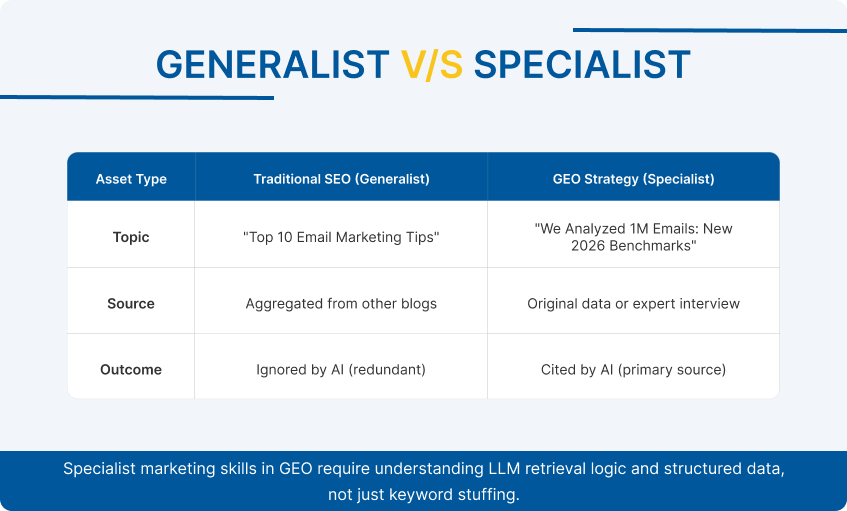
The digital marketing future is all about being a T-Shaped Human.
T-Shaped Marketer means having broad knowledge of the industry (the horizontal bar) but elite, top 1% expertise in one specific vertical (the vertical bar).
T-Shaped Marketer means having broad knowledge of the industry (the horizontal bar) but elite, top 1% expertise in one specific vertical (the vertical bar).
How to Pivot:
Audit Skills: Identify your strongest area (e.g., Data, Video, GEO).
Go Deep: Spend 80% of your time mastering that one niche.
Use AI: Let it handle the remaining 20% (generalist tasks).
By aligning with 2026 marketing trends, you become indispensable.
Go Deep: Spend 80% of your time mastering that one niche.
Use AI: Let it handle the remaining 20% (generalist tasks).
By aligning with 2026 marketing trends, you become indispensable.
Conclusion
The disappearance of the generalist marketers is not a catastrophe; it is a correction. As marketing trends 2026 reshape the landscape, the opportunity for specialists is massive. By moving away from the "Jack-of-all-trades" model and mastering a specific niche, you secure your value in the AI era.
FAQ:
1. What are the top marketing trends for 2026?
The top marketing trends 2026 include Agentic AI, Generative Engine Optimization (GEO), and Hyper-Personalization.
2. Why are generalist marketers disappearing?
They are disappearing because AI can now handle general execution tasks faster and cheaper, leaving no room for "average" work.
3. What is a T-Shaped Marketer?
A T-shaped marketer has broad industry knowledge and deep, expert-level proficiency in one specific area, which is essential for the future of digital marketing.
4. Is SEO dead in 2026?
Traditional SEO is declining; it is being replaced by GEO, which requires specialist marketing skills to optimize for AI answers using Information Gain.
5. What skills should I learn in 2026?
Focus on AI Governance, Video Commerce, and Data Architecture to align with marketing trends 2026.
6. What skills should I learn in 2026?
AI will replace generalists focused on execution; it will empower strategists who understand the future of digital marketing.

Written by / Author
Manasi Maheshwari
Found this useful? Share With
Top blogs
Most Read Blogs
Wits Innovation Lab is where creativity and innovation flourish. We provide the tools you need to come up with innovative solutions for today's businesses, big or small.
© 2026 Wits Innovation Lab, All rights reserved
Crafted in-house by WIL’s talented minds