

Published - 3 months ago | 8 min read
The AI Content Flood of 2026: Why Brands Are Running Back to Authentic Human Voices
What Is AI Content Saturation in 2026?
AI content saturation is the state where AI-generated content floods digital channels at a volume and pace that degrades audience trust, erases brand differentiation, and makes quality the scarcest commodity in the market.
That state arrived in 2025. In 2026, we are living with the consequences.
Social feeds are overwhelmed with what audiences now call "AI slop" - low-effort, repetitive content that looks polished but signals nothing. Inboxes look and read the same regardless of who sent the email. Blog content across competing brands is structurally indistinguishable. And audiences, far more perceptive than they are given credit for, noticed all of it before most marketing teams did.
The brands navigating this moment well are not the ones who went hardest on AI adoption. They are the ones who understood early that volume without voice is commercially worthless.
That state arrived in 2025. In 2026, we are living with the consequences.
Social feeds are overwhelmed with what audiences now call "AI slop" - low-effort, repetitive content that looks polished but signals nothing. Inboxes look and read the same regardless of who sent the email. Blog content across competing brands is structurally indistinguishable. And audiences, far more perceptive than they are given credit for, noticed all of it before most marketing teams did.
The brands navigating this moment well are not the ones who went hardest on AI adoption. They are the ones who understood early that volume without voice is commercially worthless.
How Bad Is AI Content Saturation in 2026? The Data
The single most revealing data point in marketing right now is the gap between what marketers are spending and what consumers actually want.
According to Billion Dollar Boy's 2025 Muse Report, which surveyed 6,000 consumers, creators, and marketing executives across the US and UK:
- 79% of marketers increased their investment in AI-generated creator content in the past 12 months
- 77% plan to shift more budget from traditional human-led creator content toward AI campaigns over the next year
- Only 26% of consumers now prefer AI-generated creator content, down from 60% in 2023
That is a 44% collapse in consumer preference across two years, running in the exact opposite direction to marketing investment.
EMARKETER's analysis of the same report describes this as the end of AI's "honeymoon phase" in creator marketing. What began as novelty became noise. And what became noise became something audiences are actively trying to escape.
Billion Dollar Boy's Chief Innovation Officer Thomas Walters put it directly: "The novelty has worn off, and mass produced, unlabelled, and poorly conceived AI 'slop' is driving the negative sentiment we are seeing."
According to Billion Dollar Boy's 2025 Muse Report, which surveyed 6,000 consumers, creators, and marketing executives across the US and UK:
- 79% of marketers increased their investment in AI-generated creator content in the past 12 months
- 77% plan to shift more budget from traditional human-led creator content toward AI campaigns over the next year
- Only 26% of consumers now prefer AI-generated creator content, down from 60% in 2023
That is a 44% collapse in consumer preference across two years, running in the exact opposite direction to marketing investment.
EMARKETER's analysis of the same report describes this as the end of AI's "honeymoon phase" in creator marketing. What began as novelty became noise. And what became noise became something audiences are actively trying to escape.
Billion Dollar Boy's Chief Innovation Officer Thomas Walters put it directly: "The novelty has worn off, and mass produced, unlabelled, and poorly conceived AI 'slop' is driving the negative sentiment we are seeing."
How Did AI Content Saturation Damage Brand Trust?
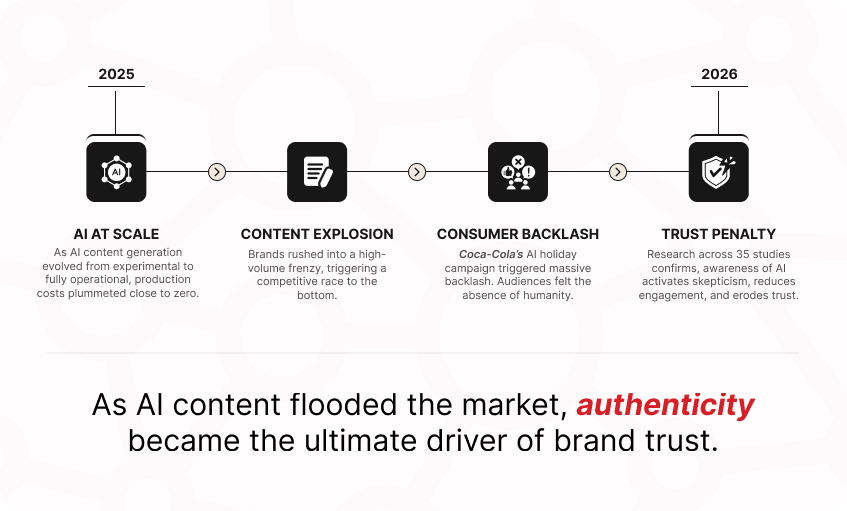
To understand where we are, it helps to understand what broke.
2025 was the year AI content generation moved from experimental to operational at scale. With tools like Sora 2 launching in September 2025, the cost of producing written, visual, and video content dropped close to zero. The natural response from marketing teams under pressure to produce was: produce more.
What happened instead was a race to the bottom that brands are still reckoning with.
The Coca-Cola case study. In December 2025, Coca-Cola released an AI-generated version of its iconic "Holidays Are Coming" campaign. The internet responded with fury. Consumers described it as "soulless" and mocked it as "the most profitable commercial in Pepsi's history." A brand that had spent decades building emotional equity in that specific seasonal spot used automation to recreate it, and audiences felt the absence of humanity immediately.
The backlash was not irrational sentiment. It was a signal about what brand trust actually depends on.
Research published in the American Impact Review in March 2026, a systematic review of 35 studies on consumer responses to AI-generated marketing content found that perceived authenticity is the primary mechanism determining whether AI content earns trust or erodes it. The study identified what it calls a "trust penalty": a consistent pattern where awareness of AI origin activates skepticism, reduces engagement, and in emotional content categories, triggers moral discomfort.
That trust penalty compounds over time. Every AI-caught moment withdraws from a brand's credibility balance, and audiences in 2026 are significantly better equipped to make the withdrawal.
2025 was the year AI content generation moved from experimental to operational at scale. With tools like Sora 2 launching in September 2025, the cost of producing written, visual, and video content dropped close to zero. The natural response from marketing teams under pressure to produce was: produce more.
What happened instead was a race to the bottom that brands are still reckoning with.
The Coca-Cola case study. In December 2025, Coca-Cola released an AI-generated version of its iconic "Holidays Are Coming" campaign. The internet responded with fury. Consumers described it as "soulless" and mocked it as "the most profitable commercial in Pepsi's history." A brand that had spent decades building emotional equity in that specific seasonal spot used automation to recreate it, and audiences felt the absence of humanity immediately.
The backlash was not irrational sentiment. It was a signal about what brand trust actually depends on.
Research published in the American Impact Review in March 2026, a systematic review of 35 studies on consumer responses to AI-generated marketing content found that perceived authenticity is the primary mechanism determining whether AI content earns trust or erodes it. The study identified what it calls a "trust penalty": a consistent pattern where awareness of AI origin activates skepticism, reduces engagement, and in emotional content categories, triggers moral discomfort.
That trust penalty compounds over time. Every AI-caught moment withdraws from a brand's credibility balance, and audiences in 2026 are significantly better equipped to make the withdrawal.
Does Authentic Marketing Actually Outperform AI Content? The Numbers
The argument for authentic marketing is not nostalgia. It is economics. Here is what the performance data shows:
1. Human-created content generates more organic traffic
Human-written content receives 5.44x more organic traffic than AI-generated equivalents, according to benchmarks from content platforms tracking engagement across equivalent topic domains. The gap is not marginal. It is structural.
2. Brand distinctiveness directly affects retention
Brands with a distinctive, consistent personality see 20% higher customer retention, per published brand strategy benchmarks. In a market where AI content makes every brand sound identical, distinctiveness is both rare and commercially valuable.
3. AI detection rates are higher than most brands assume
UCLA research has established that consumers can identify AI-generated text with 76% accuracy, even after it has been edited for flow and clarity. The 83% of consumers who report actively avoiding content they detect as AI-generated are not a fringe. They are the majority.
4. Hiding AI use accelerates trust collapse faster than using it
Mintel's 2026 UK consumer research shows that brands transparent about their AI use are rated as more trustworthy. The inverse is more damaging: consumers who discover undisclosed AI use respond with a trust collapse that affects every prior interaction with that brand, not just the content in question.
What Types of Authentic Content Perform Best in an AI-Saturated Market?
The content formats consistently outperforming right now share one characteristic: they are built on information that cannot be scraped, rephrased, and replicated at zero cost. The reset does not mean abandoning AI tools, it means investing human effort where it creates differentiation.
1. Customer stories with unscripted specificity
Not polished case studies with every rough edge removed. Actual accounts with named challenges, real numbers, honest outcomes, and the kind of friction that only exists when something actually happened to a real person.
2. Named executive and employee perspectives
A thought leadership post written by a real person with a named professional history, specific opinions, and documented expertise is GEO-visible, audience-trusted, and competitor-resistant in a way that anonymous brand content is not.
3. Behind-the-scenes process content
How decisions get made, how products are built, how teams operate. Audiences connect with evidence of effort in a way they do not connect with polished output. Process content is also structurally distinctive because it reflects what is actually true about a specific company.
4. Original research and proprietary data
Even small-scale surveys or internal benchmarks generate citeable, exclusive insight that earns audience trust and LLM retrieval. Princeton GEO research confirms that citations and statistics increase AI inclusion rates by 30 to 40%.
5. Community-sourced and user-generated content
Sprout Social's data shows 52% of consumers are concerned about brands posting AI-generated content without disclosure. UGC sidesteps that concern entirely and carries the trust signal of peer validation.
How Does AI Content Saturation Affect SEO and GEO in 2026?
Generative Engine Optimization (GEO) is now a foundational layer of content strategy. With 60% of US consumers using generative AI for product research and Gartner forecasting a 25% decline in traditional search by 2026, visibility inside ChatGPT, Perplexity, and Google AI Overviews is no longer optional for most brands.
Here is what most marketers miss: the signals that make content retrievable by LLMs are the same signals that make content trustworthy to humans.
- Named authorship and entity clarity. Consistent author credentials, a publishing history, and cross-platform presence function as crawlable trust signals for retrieval systems. Anonymous content has no entity trail and gets deprioritized accordingly.
- Information density with original data. LLMs prioritize content with named sources, specific claims, and original statistics. According to CMU's GEO framework research, pages with definitional clarity in their opening sentences score measurably higher in LLM retrieval pipelines.
- Topical authority built on genuine expertise. LLMs favor domains that cover a topic comprehensively, not just frequently. A content cluster built on real subject matter expertise outperforms a high-volume thin-content library in AI discovery channels.
- Structured transparency. Clear authorship, proper citations, and data provenance are credibility markers for audiences and crawlable quality signals for AI engines simultaneously.
The practical implication: the content strategy that wins with human audiences in 2026 and the content strategy that wins in generative engine discovery are increasingly the same strategy.
Here is what most marketers miss: the signals that make content retrievable by LLMs are the same signals that make content trustworthy to humans.
- Named authorship and entity clarity. Consistent author credentials, a publishing history, and cross-platform presence function as crawlable trust signals for retrieval systems. Anonymous content has no entity trail and gets deprioritized accordingly.
- Information density with original data. LLMs prioritize content with named sources, specific claims, and original statistics. According to CMU's GEO framework research, pages with definitional clarity in their opening sentences score measurably higher in LLM retrieval pipelines.
- Topical authority built on genuine expertise. LLMs favor domains that cover a topic comprehensively, not just frequently. A content cluster built on real subject matter expertise outperforms a high-volume thin-content library in AI discovery channels.
- Structured transparency. Clear authorship, proper citations, and data provenance are credibility markers for audiences and crawlable quality signals for AI engines simultaneously.
The practical implication: the content strategy that wins with human audiences in 2026 and the content strategy that wins in generative engine discovery are increasingly the same strategy.
Why Does AI-Generated Content Start to Sound the Same Over Time?
There is a compounding dynamic inside AI content saturation that receives far less attention than consumer preference data: model collapse.
When AI tools are trained on AI-generated content at scale, outputs become progressively more generic. The models learn from each other's linguistic patterns, reinforce common structures, and lose the edge cases, opinions, and lived specificity that make content distinctive. The content ecosystem begins feeding itself, and the outputs get flatter with every iteration.
Brands that went deep on AI content pipelines in 2024 and 2025 are discovering this effect in their own archives. Content produced at scale looks and sounds indistinguishable from competitors running the same tool stack. Brand voice did not just flatten. In many cases, it has effectively disappeared.
This is the structural argument for human-first content investment that goes beyond consumer preference surveys. It is about protecting the differentiation that makes a content library worth anything commercially over a five-year horizon.
When AI tools are trained on AI-generated content at scale, outputs become progressively more generic. The models learn from each other's linguistic patterns, reinforce common structures, and lose the edge cases, opinions, and lived specificity that make content distinctive. The content ecosystem begins feeding itself, and the outputs get flatter with every iteration.
Brands that went deep on AI content pipelines in 2024 and 2025 are discovering this effect in their own archives. Content produced at scale looks and sounds indistinguishable from competitors running the same tool stack. Brand voice did not just flatten. In many cases, it has effectively disappeared.
This is the structural argument for human-first content investment that goes beyond consumer preference surveys. It is about protecting the differentiation that makes a content library worth anything commercially over a five-year horizon.
How Are Leading Brands Balancing AI Efficiency With Authentic Voice?
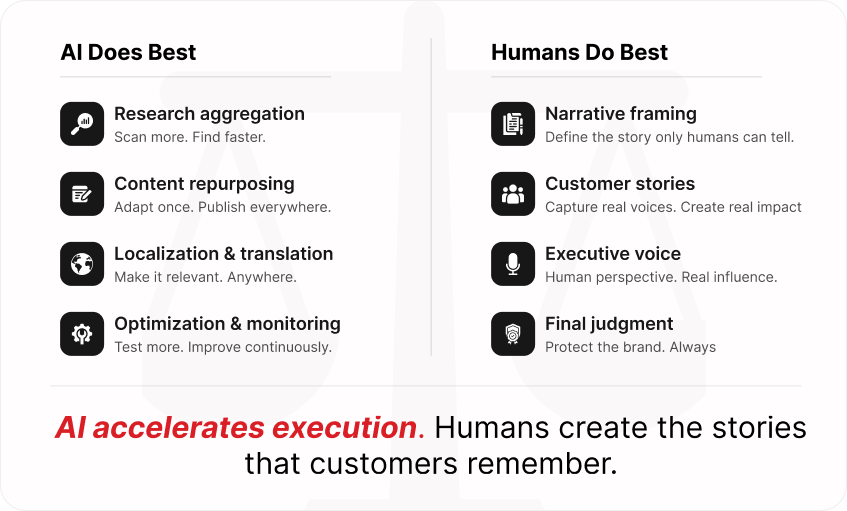
The brands navigating AI content saturation well are not choosing between efficiency and authenticity. They are sequencing their investment deliberately.
AI handles the tasks where it creates genuine operational leverage:
- Research aggregation and competitive scanning
- Content repurposing across formats
- Subject line and headline variant testing
- Localization and translation
- Distribution scheduling and performance monitoring
Humans own the decisions where brand equity is on the line:
- Narrative framing and editorial point of view
- Customer story collection and writing
- Executive voice and thought leadership
- Final judgment on any customer-facing content
Content Marketing Institute's 2025 expert survey, drawing on 42 senior practitioners, surfaces the same sequencing logic across respondents. As one contributor put it: "AI-generated drivel is flooding digital channels. That's an opportunity for brands to share authentic experiences and genuine expertise."
The brands creating that separation are building a content moat. The brands that have not started yet are running out of runway to do so.
AI handles the tasks where it creates genuine operational leverage:
- Research aggregation and competitive scanning
- Content repurposing across formats
- Subject line and headline variant testing
- Localization and translation
- Distribution scheduling and performance monitoring
Humans own the decisions where brand equity is on the line:
- Narrative framing and editorial point of view
- Customer story collection and writing
- Executive voice and thought leadership
- Final judgment on any customer-facing content
Content Marketing Institute's 2025 expert survey, drawing on 42 senior practitioners, surfaces the same sequencing logic across respondents. As one contributor put it: "AI-generated drivel is flooding digital channels. That's an opportunity for brands to share authentic experiences and genuine expertise."
The brands creating that separation are building a content moat. The brands that have not started yet are running out of runway to do so.
How to Audit Your Content Strategy for AI Saturation Risk
If your team is using AI tools without a clear framework for where human judgment is non-negotiable, these six questions are worth working through before the end of Q3:
1. Could any of your recent posts have been written by a direct competitor? If yes, your brand voice has collapsed.
2. Do your authors exist beyond the content itself? Named bios, LinkedIn presence, and publication history are GEO signals as much as trust signals.
3. Where does original data live in your content calendar? Even small proprietary research generates citeable, exclusive content that earns both audience trust and AI retrieval.
4. What is your disclosure posture on AI use? Hiding AI use is more commercially damaging than transparent use.
5. What content can your competitor replicate by running the same AI prompt? Anything in that category is not differentiated content.
6. Where is human editorial judgment non-negotiable in your workflow? If you have not defined this, AI will expand to fill the space by default.
1. Could any of your recent posts have been written by a direct competitor? If yes, your brand voice has collapsed.
2. Do your authors exist beyond the content itself? Named bios, LinkedIn presence, and publication history are GEO signals as much as trust signals.
3. Where does original data live in your content calendar? Even small proprietary research generates citeable, exclusive content that earns both audience trust and AI retrieval.
4. What is your disclosure posture on AI use? Hiding AI use is more commercially damaging than transparent use.
5. What content can your competitor replicate by running the same AI prompt? Anything in that category is not differentiated content.
6. Where is human editorial judgment non-negotiable in your workflow? If you have not defined this, AI will expand to fill the space by default.
Conclusion
AI content saturation in 2026 is a differentiation crisis more than a technology problem.
The flood of generated content has made human insight, original perspective, and authentic voice scarcer than they have been at any point in modern marketing. That scarcity creates commercial value. Brands that invested in genuine voice before the reset are sitting on something defensible. Brands that did not are competing on a platform that commoditized itself.
Authentic marketing is the rational response to a market where everything that can be generated cheaply already has been, and audiences are actively looking for evidence that a human being still cares what they think.
The brands that figure this out first will not just outperform on content metrics. They will own the trust premium that converts into retention, pricing power, and advocacy in ways that no AI pipeline can replicate.
The flood of generated content has made human insight, original perspective, and authentic voice scarcer than they have been at any point in modern marketing. That scarcity creates commercial value. Brands that invested in genuine voice before the reset are sitting on something defensible. Brands that did not are competing on a platform that commoditized itself.
Authentic marketing is the rational response to a market where everything that can be generated cheaply already has been, and audiences are actively looking for evidence that a human being still cares what they think.
The brands that figure this out first will not just outperform on content metrics. They will own the trust premium that converts into retention, pricing power, and advocacy in ways that no AI pipeline can replicate.

Written by / Author
Manasi Maheshwari
Found this useful? Share With
Top blogs
Most Read Blogs
Wits Innovation Lab is where creativity and innovation flourish. We provide the tools you need to come up with innovative solutions for today's businesses, big or small.
© 2026 Wits Innovation Lab, All rights reserved
Crafted in-house by WIL’s talented minds