

Published - 4 months ago | 8 min read
Social Media Crisis: How One Comment Destroyed a Brand
There is a moment every brand manager dreads. A post that seemed perfectly fine at 9 a.m. is a trending disaster by noon. The comment section has turned into a war zone, screenshots are circulating on every platform, journalists are calling, and the executive team is asking what happened. The brutal truth of modern business is this: years of brand equity can evaporate in a single afternoon. Not because of a product failure or a court case, but because of how a company handled, or mishandled, what was said in a comment section.
Social media has fundamentally changed the rules of reputation management. It has handed every consumer a megaphone and every critic a global audience. Understanding why these crises happen, how they escalate, and what separates the brands that survive from those that collapse is no longer optional knowledge for communications teams. It is survival knowledge for the entire organization.
Social media has fundamentally changed the rules of reputation management. It has handed every consumer a megaphone and every critic a global audience. Understanding why these crises happen, how they escalate, and what separates the brands that survive from those that collapse is no longer optional knowledge for communications teams. It is survival knowledge for the entire organization.
The Speed of Collapse Has Changed Forever
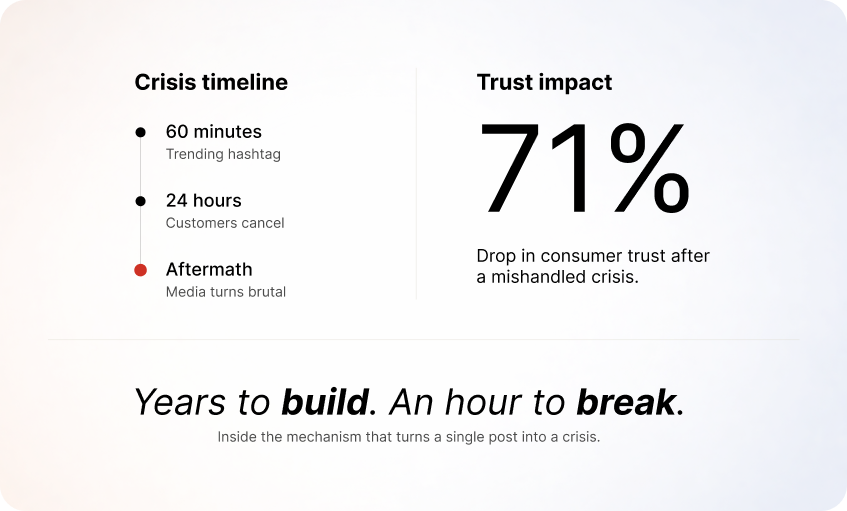
The first thing that strikes any observer who studies modern social media crises is the sheer velocity of collapse. A mistake can become a trending hashtag within sixty minutes. By the next day, customers have canceled accounts, and media coverage turns brutal. That IS a realistic timeline that every brand must plan around.
The mechanism behind this speed is worth understanding. Within minutes of a negative post, users begin tagging friends, influencers join the conversation to gain engagement, and the story takes on a life of its own. This rapid amplification creates a vacuum of information. If the brand remains silent, the public fills that vacuum with speculation, rumors, and often outright misinformation. Social media algorithms then do the rest, prioritizing trending topics and pushing the crisis to the top of feeds at precisely the moment the brand is scrambling internally to figure out who should respond. The outcome is predictable. Consumer trust can drop by 71% after a mishandled crisis.
The mechanism behind this speed is worth understanding. Within minutes of a negative post, users begin tagging friends, influencers join the conversation to gain engagement, and the story takes on a life of its own. This rapid amplification creates a vacuum of information. If the brand remains silent, the public fills that vacuum with speculation, rumors, and often outright misinformation. Social media algorithms then do the rest, prioritizing trending topics and pushing the crisis to the top of feeds at precisely the moment the brand is scrambling internally to figure out who should respond. The outcome is predictable. Consumer trust can drop by 71% after a mishandled crisis.
Case Study 1: United Airlines and the $770 Million Comment Problem
No modern case study captures the anatomy of a social media crisis more vividly than United Airlines in April 2017. On 9 April, security officers forcibly removed Dr. David Dao from an overbooked flight at Chicago O'Hare International Airport. Multiple smartphone videos captured the confrontation, and before the plane touched down in Louisville, the incident had been viewed by people all over the world.
The videos were damaging enough. What turned this from a serious incident into a landmark catastrophe was the response. CEO Oscar Munoz apologized only for having to "re-accommodate customers," and many customers found the response to be overly callous, saying so on social media where the video had already gone viral. An internal letter Munoz sent to employees was then leaked, in which he described the passenger as "disruptive and belligerent" and said that employees had followed established procedures.
The financial damage was swift. United shares fell 4% over the course of the week, reducing the company's market cap by $770 million. The crisis also spread internationally. The top trending topic on Weibo, China's equivalent of Twitter, attracted more than 100 million views, dealing profound damage in what was United's most important international growth market.
What made this crisis uniquely instructive was how the response actively compounded the damage. As one financial analyst told CNBC at the time, the CEO and executives "threw gasoline on a fire," with each new statement restarting the crisis and causing negative mentions to surge on social media for a second and third time.
The videos were damaging enough. What turned this from a serious incident into a landmark catastrophe was the response. CEO Oscar Munoz apologized only for having to "re-accommodate customers," and many customers found the response to be overly callous, saying so on social media where the video had already gone viral. An internal letter Munoz sent to employees was then leaked, in which he described the passenger as "disruptive and belligerent" and said that employees had followed established procedures.
The financial damage was swift. United shares fell 4% over the course of the week, reducing the company's market cap by $770 million. The crisis also spread internationally. The top trending topic on Weibo, China's equivalent of Twitter, attracted more than 100 million views, dealing profound damage in what was United's most important international growth market.
What made this crisis uniquely instructive was how the response actively compounded the damage. As one financial analyst told CNBC at the time, the CEO and executives "threw gasoline on a fire," with each new statement restarting the crisis and causing negative mentions to surge on social media for a second and third time.
Case Study 2: Nestlé and the Comment Section That Could Not Be Silenced
If United Airlines shows what happens when a response is tone-deaf, Nestlé's 2010 KitKat crisis shows what happens when a brand tries to make a conversation disappear entirely.
In March 2010, Greenpeace launched a campaign accusing Nestlé of buying palm oil from the controversial Indonesian supplier Sinar Mas, which it said was clearing orangutan habitats and breaking Indonesian law to expand production. The campaign featured a parody video of the famous KitKat advertisement, which went viral almost immediately. The video received over 40,000 views on YouTube and over 100,000 views on Vimeo within the first 20 hours.
Nestlé's instinct was to fight the conversation rather than engage with it. Nestlé asked YouTube to remove the clip, citing copyright concerns, but the campaign spread further across other platforms as a result. When protesters flooded Nestlé's own Facebook page, the company deleted negative comments and warned users against posting with altered versions of its logo. That response further angered online users and escalated the situation into a major social media crisis. The backlash became extraordinary in scale. The incident generated an overwhelming buzz on Twitter, with more than 215,000 related tweets in a nine-day period.
Nestlé eventually ended its relationship with the supplier, but the lesson was already written into crisis management textbooks. Attempting to censor criticism on social media does not extinguish it. It accelerates and amplifies the very damage a brand is trying to contain.
In March 2010, Greenpeace launched a campaign accusing Nestlé of buying palm oil from the controversial Indonesian supplier Sinar Mas, which it said was clearing orangutan habitats and breaking Indonesian law to expand production. The campaign featured a parody video of the famous KitKat advertisement, which went viral almost immediately. The video received over 40,000 views on YouTube and over 100,000 views on Vimeo within the first 20 hours.
Nestlé's instinct was to fight the conversation rather than engage with it. Nestlé asked YouTube to remove the clip, citing copyright concerns, but the campaign spread further across other platforms as a result. When protesters flooded Nestlé's own Facebook page, the company deleted negative comments and warned users against posting with altered versions of its logo. That response further angered online users and escalated the situation into a major social media crisis. The backlash became extraordinary in scale. The incident generated an overwhelming buzz on Twitter, with more than 215,000 related tweets in a nine-day period.
Nestlé eventually ended its relationship with the supplier, but the lesson was already written into crisis management textbooks. Attempting to censor criticism on social media does not extinguish it. It accelerates and amplifies the very damage a brand is trying to contain.
Case Study 3: Balenciaga and the Crisis That Froze a Brand
In November 2022, luxury fashion house Balenciaga released a holiday gifting campaign that featured child models alongside products that sparked immediate and severe public outrage. The hashtags #burnbalenciaga and #cancelbalenciaga accumulated more than 300 million views on TikTok, and the brand suffered vandalism at its flagship stores alongside a viral online boycott.
The brand's initial crisis response made a severe situation significantly worse. Balenciaga had a slow and unclear response to the initial backlash that ultimately led to the wider crisis. The brand took days to fully address the issue, published several inconclusive statements, and failed to assume responsibility. When it did act more decisively, the brand launched a $25 million lawsuit against a production company, which was widely interpreted as an attempt to shift blame. Public relations professionals and legal experts suggested that Balenciaga would have fared more favorably had it taken responsibility from the outset rather than attempting to blame others.
The commercial consequences were severe and measurable. The brand lost 100,000 Instagram followers, fell out of the Lyst Index's top 10 brands, and witnessed a significant decline in sales during Kering's fourth quarter of 2022. After the crisis, Balenciaga froze its two most important social media platforms entirely, stopped posting, muted all comments, and its growth and performance froze alongside them. The Balenciaga case is particularly instructive because the brand occupied a position of genuine cultural influence before the crisis. Shock-driven creative work had been a deliberate strategy. What November 2022 revealed is that no amount of prior brand equity provides immunity when a comment section catches fire, and that a defensive, slow, and blame-shifting response can take a crisis that might have been survivable and make it permanent.
The brand's initial crisis response made a severe situation significantly worse. Balenciaga had a slow and unclear response to the initial backlash that ultimately led to the wider crisis. The brand took days to fully address the issue, published several inconclusive statements, and failed to assume responsibility. When it did act more decisively, the brand launched a $25 million lawsuit against a production company, which was widely interpreted as an attempt to shift blame. Public relations professionals and legal experts suggested that Balenciaga would have fared more favorably had it taken responsibility from the outset rather than attempting to blame others.
The commercial consequences were severe and measurable. The brand lost 100,000 Instagram followers, fell out of the Lyst Index's top 10 brands, and witnessed a significant decline in sales during Kering's fourth quarter of 2022. After the crisis, Balenciaga froze its two most important social media platforms entirely, stopped posting, muted all comments, and its growth and performance froze alongside them. The Balenciaga case is particularly instructive because the brand occupied a position of genuine cultural influence before the crisis. Shock-driven creative work had been a deliberate strategy. What November 2022 revealed is that no amount of prior brand equity provides immunity when a comment section catches fire, and that a defensive, slow, and blame-shifting response can take a crisis that might have been survivable and make it permanent.
Case Study 4: Burger King and the Danger of Context Buried in a Thread
Not every social media crisis originates from genuine wrongdoing. Sometimes the damage comes from a gap between intent and execution that the comment section exploits in seconds.
On International Women's Day in March 2021, Burger King UK posted a tweet that read simply: "Women belong in the kitchen." The restaurant followed up with a subsequent message explaining that only 20 percent of chefs are women and that the brand was launching a scholarship to support female employees pursuing culinary careers. The problem was that the opening tweet spread entirely on its own terms. The "Women belong in the kitchen" tweet was retweeted more than 125,000 times, while the other two messages in the thread had fewer than 10,000 combined.
The apology appeared nearly 12 hours later, after the initial tweet had been covered widely by media around the world. The scholarship programme, the entire point of the campaign, was entirely lost in the noise. The lesson is a simple but costly one: lead with context. Critical nuance cannot be left to a follow-up tweet or buried in small print.
The Burger King case differs from the others in one important respect. The intention was genuinely positive. The crisis was created not by the message itself but by the structure in which it was delivered, and by the assumption that audiences would follow a thread to its conclusion before forming a reaction. On social media in 2021, they did not. The opening line was the entire story.
On International Women's Day in March 2021, Burger King UK posted a tweet that read simply: "Women belong in the kitchen." The restaurant followed up with a subsequent message explaining that only 20 percent of chefs are women and that the brand was launching a scholarship to support female employees pursuing culinary careers. The problem was that the opening tweet spread entirely on its own terms. The "Women belong in the kitchen" tweet was retweeted more than 125,000 times, while the other two messages in the thread had fewer than 10,000 combined.
The apology appeared nearly 12 hours later, after the initial tweet had been covered widely by media around the world. The scholarship programme, the entire point of the campaign, was entirely lost in the noise. The lesson is a simple but costly one: lead with context. Critical nuance cannot be left to a follow-up tweet or buried in small print.
The Burger King case differs from the others in one important respect. The intention was genuinely positive. The crisis was created not by the message itself but by the structure in which it was delivered, and by the assumption that audiences would follow a thread to its conclusion before forming a reaction. On social media in 2021, they did not. The opening line was the entire story.
The Pattern Behind Every Crisis
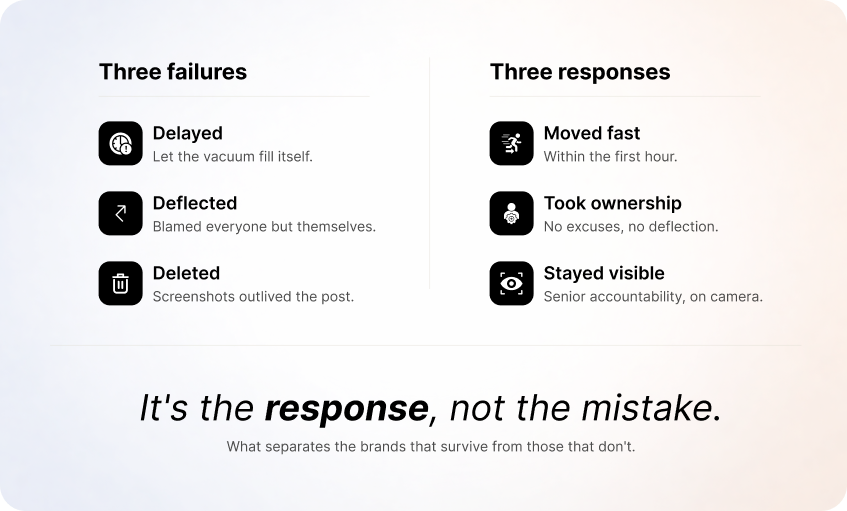
Looking across these four cases, a consistent pattern emerges. A social media crisis has specific characteristics: viral spread that gains exponential visibility in a short period, the need for immediate attention where delay exacerbates the situation, and the potential for long-term damage to reputation and financial health if left unaddressed.
The trigger is often less important than the response. Brands that experienced the worst outcomes delayed, deflected, or deleted. Those who recovered fastest moved quickly, took ownership, and communicated with visible senior accountability.
Deletion is particularly dangerous. Removing posts without explanation can suggest guilt or avoidance. On social media, where screenshots are permanent, deletion rarely removes the content. It simply adds a new narrative to the existing one: that the brand is trying to hide something.
The trigger is often less important than the response. Brands that experienced the worst outcomes delayed, deflected, or deleted. Those who recovered fastest moved quickly, took ownership, and communicated with visible senior accountability.
Deletion is particularly dangerous. Removing posts without explanation can suggest guilt or avoidance. On social media, where screenshots are permanent, deletion rarely removes the content. It simply adds a new narrative to the existing one: that the brand is trying to hide something.
The Numbers That Define the Stakes
The data on crisis response timing is unambiguous. According to research by the Public Relations Society of America, brands that respond within the first hour are 85% more likely to maintain public confidence during a potential crisis. Studies by Sprinklr indicate that brands responding within two hours of a crisis breaking see 61% better sentiment recovery compared to delayed responses. Consumer expectations are equally clear. McKinsey reports that 50% of consumers post complaints publicly after bad experiences, and 81% say they will avoid brands that do not respond publicly.
There is, however, a compelling case for measured optimism here. Research shows that 72% of consumers will continue to do business with a brand that has experienced a crisis but addresses it swiftly and sincerely. A well-managed crisis does not merely limit damage. Handled correctly, it can strengthen the relationship between a brand and its audience in ways that ordinary communications simply cannot.
There is, however, a compelling case for measured optimism here. Research shows that 72% of consumers will continue to do business with a brand that has experienced a crisis but addresses it swiftly and sincerely. A well-managed crisis does not merely limit damage. Handled correctly, it can strengthen the relationship between a brand and its audience in ways that ordinary communications simply cannot.
Conclusion
The comment section that destroys a brand overnight rarely appears without warning. It is usually the endpoint of a conversation that went unmonitored. Most PR crises do not come out of nowhere. There are signs first: subtle shifts in public sentiment, sudden increases in mentions, and emerging keywords that appear a day or two before the issue takes off.
The comment section is not the enemy. Unmonitored, it becomes a liability. Actively listened to, it is one of the most valuable sources of consumer intelligence available to any brand. The difference between those two outcomes is not luck. It is preparation, organizational culture, and the willingness to treat public conversation as something worth taking seriously, long before it becomes a crisis.
The comment section is not the enemy. Unmonitored, it becomes a liability. Actively listened to, it is one of the most valuable sources of consumer intelligence available to any brand. The difference between those two outcomes is not luck. It is preparation, organizational culture, and the willingness to treat public conversation as something worth taking seriously, long before it becomes a crisis.

Written by / Author
Manasi Maheshwari
Found this useful? Share With
Top blogs
Most Read Blogs
Wits Innovation Lab is where creativity and innovation flourish. We provide the tools you need to come up with innovative solutions for today's businesses, big or small.
© 2026 Wits Innovation Lab, All rights reserved
Crafted in-house by WIL’s talented minds