

Published - a month ago | 7 min read
How to Migrate to Post-Quantum Cryptography: A Step-by-Step Guide for 2026
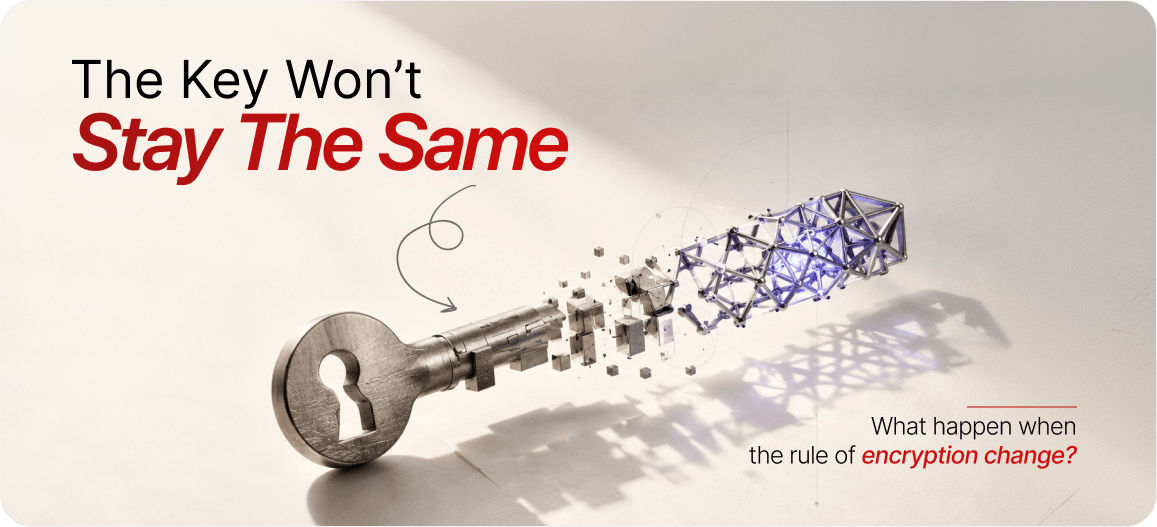
Picture a hospital sending encrypted patient records to a partner lab today. The encryption works fine. Nobody can read the file in transit. But someone could still copy that file, store it, and wait. If a powerful enough quantum computer arrives in ten years, that stored file could suddenly become readable, medical history and all.
This is the practical reason quantum cryptography has moved from a research topic to a planning item on real security roadmaps. Data with a long shelf life, things like health records, financial history, and legal documents, needs protection that holds up years from now, not just protection that works today. That is why more organizations are asking how to migrate to post-quantum cryptography in 2026, while there is still time to plan the transition instead of reacting to it.
This guide walks through what post-quantum cryptography actually means, why the timeline matters more than most people realize, and the concrete steps your organization can take in 2026 to move toward quantum-safe systems.
This is the practical reason quantum cryptography has moved from a research topic to a planning item on real security roadmaps. Data with a long shelf life, things like health records, financial history, and legal documents, needs protection that holds up years from now, not just protection that works today. That is why more organizations are asking how to migrate to post-quantum cryptography in 2026, while there is still time to plan the transition instead of reacting to it.
This guide walks through what post-quantum cryptography actually means, why the timeline matters more than most people realize, and the concrete steps your organization can take in 2026 to move toward quantum-safe systems.
What Is Post-Quantum Cryptography
Post-quantum cryptography refers to encryption methods designed to stay secure even against attacks from powerful quantum computers. Today's most common encryption methods, such as RSA and elliptic curve cryptography, rely on math problems that are extremely hard for regular computers to solve. A large enough quantum computer could solve these problems in a fraction of the time, using an approach known as Shor's algorithm.
Quantum cryptography, in the sense most people mean when they search for it, is really about building new encryption standards that do not depend on the math problems quantum computers are good at breaking. These new standards are based on different mathematical structures, such as lattice problems, that are believed to resist both classical and quantum attacks.
The United States National Institute of Standards and Technology, known as NIST, has led a multi-year public process to select and standardize these new algorithms. In 2024, NIST published its first finalized post-quantum cryptography standards, including algorithms for general encryption and digital signatures. This gives organizations a real, tested foundation to build on, rather than guessing at future requirements.
Quantum cryptography, in the sense most people mean when they search for it, is really about building new encryption standards that do not depend on the math problems quantum computers are good at breaking. These new standards are based on different mathematical structures, such as lattice problems, that are believed to resist both classical and quantum attacks.
The United States National Institute of Standards and Technology, known as NIST, has led a multi-year public process to select and standardize these new algorithms. In 2024, NIST published its first finalized post-quantum cryptography standards, including algorithms for general encryption and digital signatures. This gives organizations a real, tested foundation to build on, rather than guessing at future requirements.
Why the Migration Timeline Matters Right Now
A common misconception is that post-quantum migration can wait until quantum computers capable of breaking current encryption actually exist. This thinking misses a serious risk called "harvest now, decrypt later." In this scenario, attackers collect encrypted data today, even though they cannot read it yet, and simply wait until quantum computers are powerful enough to decrypt it later.
This matters most for data that needs to stay confidential for many years. Health records, financial data, government communications, legal documents, and trade secrets often fall into this category. If that kind of data is being intercepted and stored today, waiting to migrate does not protect it. The damage is already set in motion.
Government agencies have taken this seriously. The U.S. National Security Agency has directed that National Security Systems begin transitioning to quantum-resistant algorithms well before large-scale quantum computers are expected to arrive, precisely because of this harvest-now risk. Similar guidance has come from cybersecurity authorities in Europe through the European Union Agency for Cybersecurity.
This is the core reason organizations are now asking how to migrate to post-quantum cryptography instead of waiting for a clearer deadline. The safe window to act is now, while data is still being created and encrypted, not after a quantum computer capable of breaking today's encryption is confirmed to exist.
This matters most for data that needs to stay confidential for many years. Health records, financial data, government communications, legal documents, and trade secrets often fall into this category. If that kind of data is being intercepted and stored today, waiting to migrate does not protect it. The damage is already set in motion.
Government agencies have taken this seriously. The U.S. National Security Agency has directed that National Security Systems begin transitioning to quantum-resistant algorithms well before large-scale quantum computers are expected to arrive, precisely because of this harvest-now risk. Similar guidance has come from cybersecurity authorities in Europe through the European Union Agency for Cybersecurity.
This is the core reason organizations are now asking how to migrate to post-quantum cryptography instead of waiting for a clearer deadline. The safe window to act is now, while data is still being created and encrypted, not after a quantum computer capable of breaking today's encryption is confirmed to exist.
Step-by-Step Guide to Migrating to Post-Quantum Cryptography
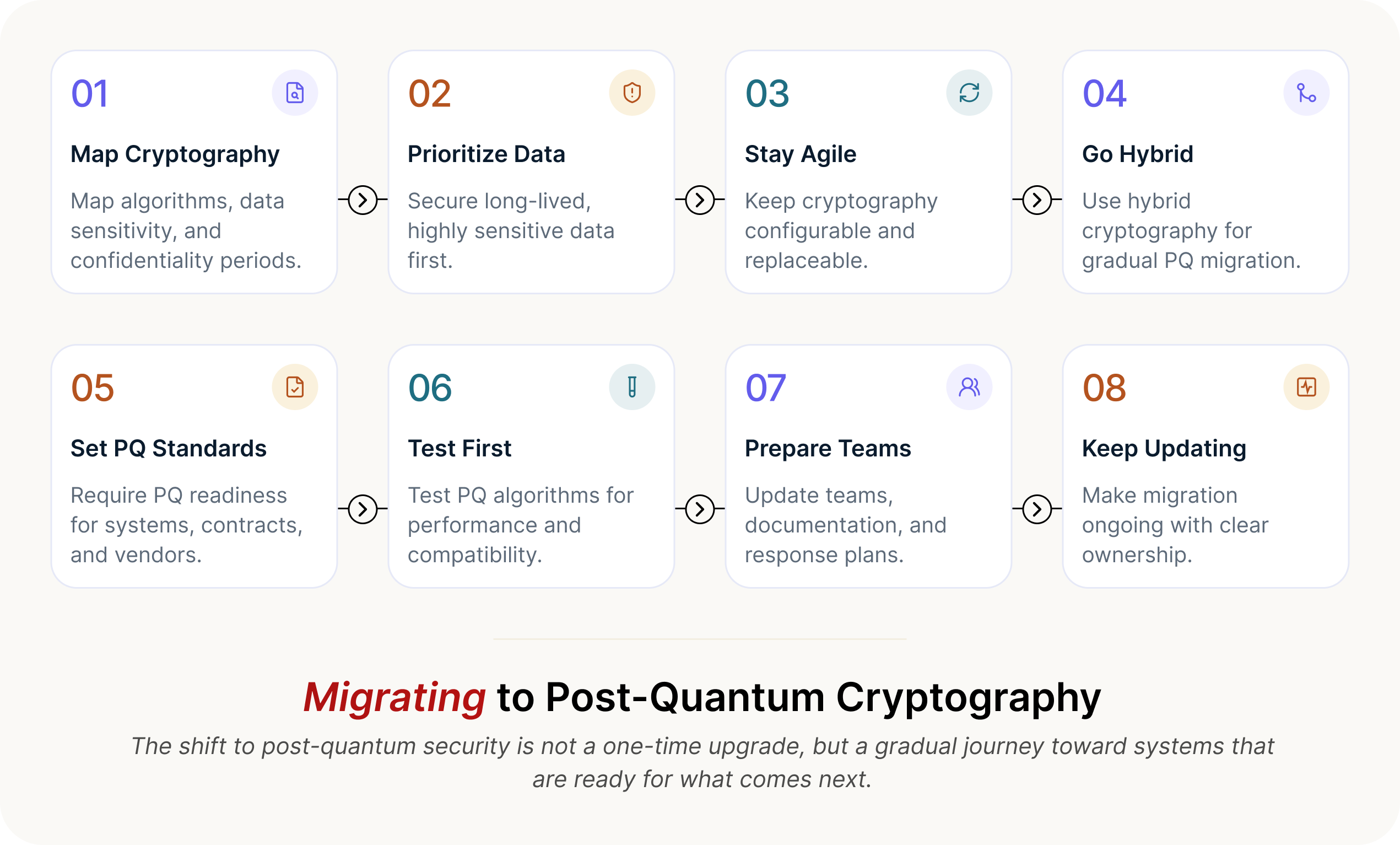
Step 1: Build a Cryptographic Inventory
You cannot protect what you do not know you have. The first step is creating a full inventory of every place your organization uses cryptography. This includes obvious places like websites and email systems, but also less visible ones such as internal APIs, firmware, backup systems, IoT devices, VPNs, and third-party software.
For each item, record which algorithm is used, where it is used, how sensitive the protected data is, and how long that data needs to stay confidential. This inventory becomes the map for everything that follows.
For each item, record which algorithm is used, where it is used, how sensitive the protected data is, and how long that data needs to stay confidential. This inventory becomes the map for everything that follows.
Step 2: Prioritize Based on Risk and Data Lifespan
Not everything needs to move at the same speed. Prioritize systems that protect long-lived sensitive data first, since this is where the harvest-now risk is highest. Public-facing systems handling health, financial, legal, or government information should usually sit at the top of the list.
Lower-priority systems, such as internal tools handling short-lived, low-sensitivity data, can generally wait until later phases of the migration.
Lower-priority systems, such as internal tools handling short-lived, low-sensitivity data, can generally wait until later phases of the migration.
Step 3: Adopt Crypto-Agility as a Design Principle
Crypto-agility means designing systems so that cryptographic algorithms can be swapped out without rebuilding the entire system from scratch. This is one of the most important lessons from the migration process so far. Standards will continue to evolve, and some algorithms may later be found to have weaknesses.
Building systems that treat the cryptographic algorithm as a configurable component, rather than something hardcoded deep into the architecture, makes every future transition faster and less disruptive.
Building systems that treat the cryptographic algorithm as a configurable component, rather than something hardcoded deep into the architecture, makes every future transition faster and less disruptive.
Step 4: Start With Hybrid Cryptography
Rather than switching directly from classical to post-quantum algorithms, most organizations are adopting a hybrid approach. This means combining a classical algorithm with a post-quantum algorithm at the same time, so data stays protected even if a weakness is later found in either method alone.
Hybrid approaches are already being tested and deployed in real systems, including in TLS connections used to secure web traffic. This gives organizations a safer, gradual path rather than a risky all-at-once switch.
Hybrid approaches are already being tested and deployed in real systems, including in TLS connections used to secure web traffic. This gives organizations a safer, gradual path rather than a risky all-at-once switch.
Step 5: Update Standards, Vendors, and Contracts
Once priorities are set, update internal security standards to require post-quantum or hybrid algorithms for new systems and renewed contracts. Ask software and hardware vendors directly about their post-quantum roadmap. If a vendor cannot answer clearly, that is a signal to plan for eventual replacement.
Procurement and legal teams should also be looped in here, since long-term contracts and hardware purchases made today may still be in use well past the point where post-quantum support becomes mandatory in certain industries.
Procurement and legal teams should also be looped in here, since long-term contracts and hardware purchases made today may still be in use well past the point where post-quantum support becomes mandatory in certain industries.
Step 6: Test in Controlled Environments Before Full Rollout
Post-quantum algorithms often require larger key sizes and different performance characteristics compared to classical algorithms. This can affect things like page load times, device battery life, and system compatibility, especially on older hardware.
Test new algorithms in staging environments first. Measure performance impact, check for compatibility issues with existing systems, and confirm that certificates and key exchange processes work as expected before moving to production.
Test new algorithms in staging environments first. Measure performance impact, check for compatibility issues with existing systems, and confirm that certificates and key exchange processes work as expected before moving to production.
Step 7: Train Teams and Update Documentation
Migration is not only a technical project. Security teams, developers, and IT staff need to understand why the change is happening and how the new systems work. Update internal documentation, incident response plans, and onboarding materials to reflect the new standards.
Step 8: Monitor Standards and Plan for Ongoing Updates
Post-quantum cryptography is still a developing field. NIST and other standards bodies continue to review, test, and occasionally revise guidance as new research emerges. Treat this migration as an ongoing program rather than a one-time project. Assign clear ownership so someone is responsible for tracking updates and coordinating future changes.
Common Challenges Organizations Face
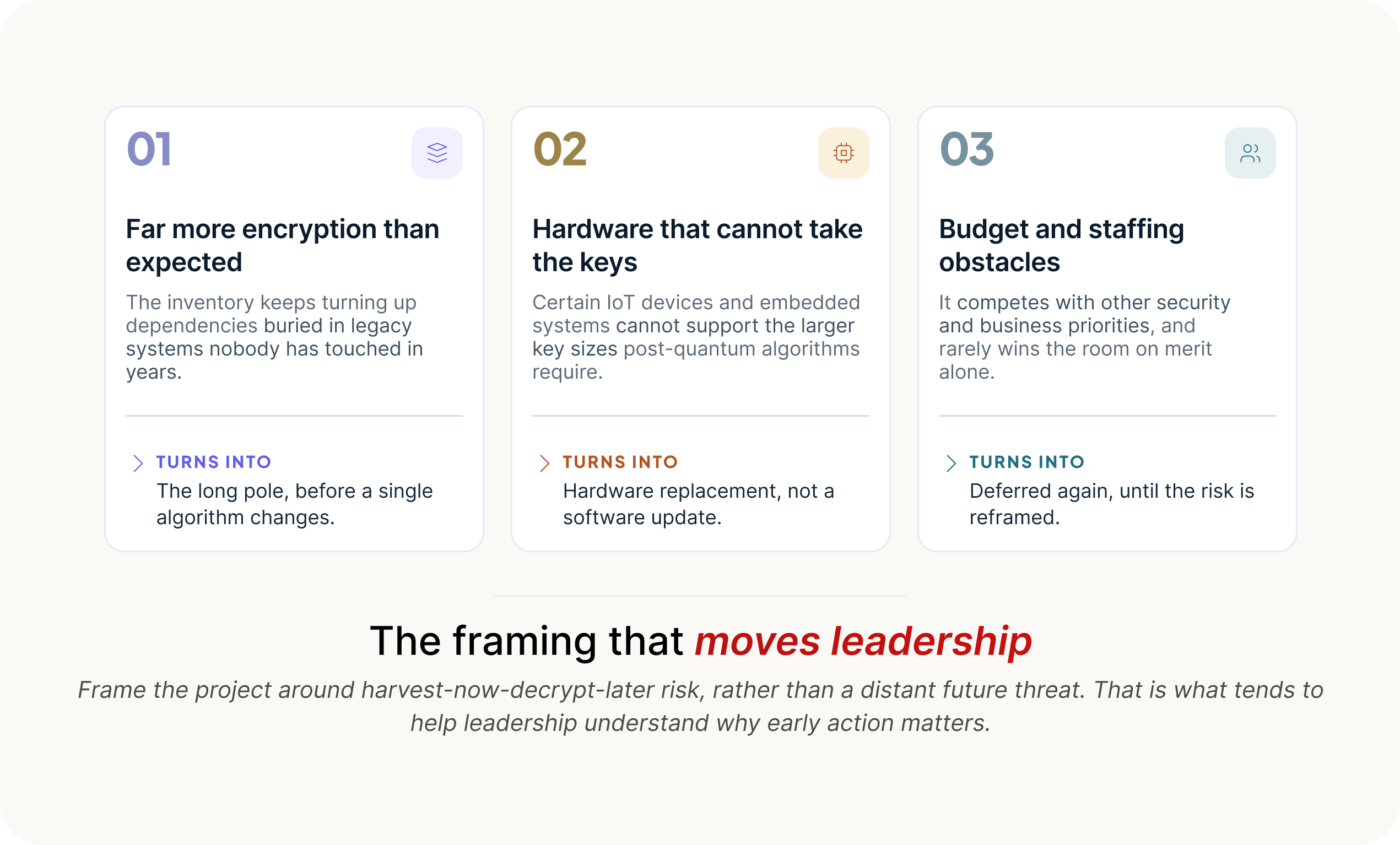
Many organizations discover during their cryptographic inventory that they have far more encryption dependencies than expected, often buried in legacy systems nobody has touched in years. Others find that older hardware, such as certain IoT devices or embedded systems, cannot support the larger key sizes that post-quantum algorithms require, which may mean hardware replacement rather than a simple software update.
Budget and staffing are also common obstacles, since this kind of migration competes with other security and business priorities. Framing the project around the harvest-now-decrypt-later risk, rather than a distant future threat, tends to help leadership understand why early action matters.
Budget and staffing are also common obstacles, since this kind of migration competes with other security and business priorities. Framing the project around the harvest-now-decrypt-later risk, rather than a distant future threat, tends to help leadership understand why early action matters.
Bringing It All Together
Learning how to migrate to post-quantum cryptography is less about a single switch and more about a structured, ongoing program. It starts with knowing what you have, prioritizing based on real risk, and building systems flexible enough to adapt as standards continue to mature. Quantum cryptography standards are now established enough to act on, and the organizations moving early are the ones protecting long-lived sensitive data before it becomes vulnerable.
The technology behind quantum computing will keep advancing. Waiting for certainty about exact timelines is not a safe strategy, since sensitive data intercepted today could be exposed years from now. Starting the inventory and prioritization work in 2026 gives your organization a realistic path to quantum-safe systems, built at a pace that fits your actual risk rather than a reaction to sudden pressure later.
The technology behind quantum computing will keep advancing. Waiting for certainty about exact timelines is not a safe strategy, since sensitive data intercepted today could be exposed years from now. Starting the inventory and prioritization work in 2026 gives your organization a realistic path to quantum-safe systems, built at a pace that fits your actual risk rather than a reaction to sudden pressure later.
Frequently Asked Questions
1. Is post-quantum cryptography the same as quantum cryptography?
Not exactly. Quantum cryptography sometimes refers to methods that use quantum physics itself to secure communication, such as quantum key distribution. Post-quantum cryptography instead refers to classical algorithms designed to resist attacks from quantum computers. Most organizations migrating today are working with post-quantum algorithms, since they can run on existing classical hardware and networks.
2. How long does a full migration take?
This depends heavily on the size and complexity of the organization. A full cryptographic inventory alone can take months for large organizations. Full migration, including hybrid deployment, testing, and vendor updates, is typically measured in years rather than months.
3. Do small organizations need to worry about this too?
Yes, though the urgency depends on what data is being protected and for how long. Organizations handling health records, financial data, or other long-lived sensitive information should start planning now, regardless of size.

Written by / Author
Manasi Maheshwari
Found this useful? Share With
Top blogs
Most Read Blogs
Wits Innovation Lab is where creativity and innovation flourish. We provide the tools you need to come up with innovative solutions for today's businesses, big or small.
© 2026 Wits Innovation Lab, All rights reserved
Crafted in-house by WIL’s talented minds