

Published - 10 months ago | 8 min read
How to Build Products That Actually Solve Customer Problems?
Building a product begins with a simple idea: solve a problem you understand. The trouble starts when that problem belongs to you instead of your customers. Many early founders build a product from personal experience, personal frustration, and personal assumptions. The result is a polished product that never connects with the market. This matters because customer expectations shift faster than internal assumptions. Most teams underestimate this gap, which is why 95% of software products fail long before they reach real adoption. A product that fits your workflow won’t always fit theirs, and that mismatch quietly kills adoption. This guide explains why that happens, why you should stop building your product for yourself, and how to build with customer truth rather than founder memory.
Why Founders Build Products for Themselves
Founders rarely start with customers. They start with a memory:
- a workflow that once frustrated them,
- a tool they wished existed,
- an idea formed inside an old job.
That memory becomes the blueprint.
And that is where the gap begins.
When you build product from past assumptions, you create a product that perfectly fits the world you used to live in, not the world your customers live in today.
- a workflow that once frustrated them,
- a tool they wished existed,
- an idea formed inside an old job.
That memory becomes the blueprint.
And that is where the gap begins.
When you build product from past assumptions, you create a product that perfectly fits the world you used to live in, not the world your customers live in today.
Signs Your Product Is Built for You, Not Your Users
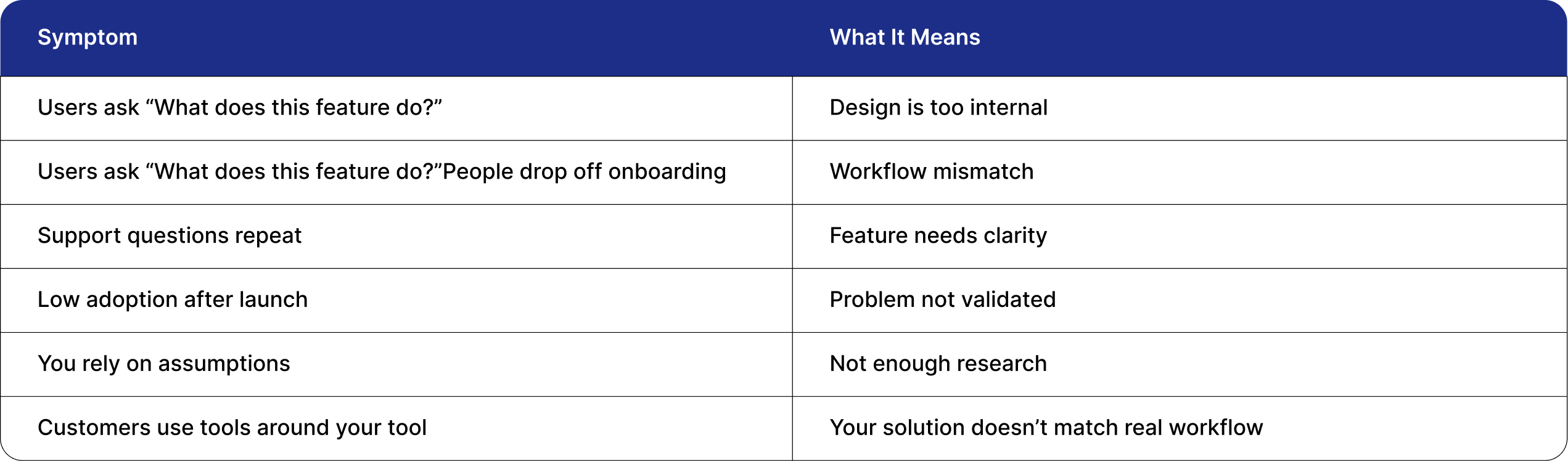
These signs are quiet warnings. They show where technology doesn’t meet reality.
Why Founders Should Not Build the Product Themselves
Founders who can build often believe they should.
- It feels efficient.
- It feels fast.
- It feels safe.
But building software yourself creates blind spots that compound over time.
- It feels efficient.
- It feels fast.
- It feels safe.
But building software yourself creates blind spots that compound over time.
You build from memory instead of market truth
Your past job is not your current customer. Yet most founder-built products replicate old workflows, not actual field problems users face today.
You can't validate and build at the same time
Building locks you into execution mode. Validation requires distance. You need space to notice patterns in interviews, competitor gaps, adoption behavior, and actual user workflows.
- Coding forces you into details.
- Validation requires perspective.
- You cannot sit on both sides of the table at once.
- Coding forces you into details.
- Validation requires perspective.
- You cannot sit on both sides of the table at once.
You skip essential steps because speed feels like progress
Most founders start writing code before they collect evidence.
It’s just feels satisfying to “ship.”
The result is a beautiful solution that solves the wrong problem.
It’s just feels satisfying to “ship.”
The result is a beautiful solution that solves the wrong problem.
You become the product’s main user
When a founder writes the code, the product starts reflecting their habits.
- You build shortcuts for yourself.
- You design flows you understand deeply.
- You optimize for your own mental model.
Users rarely think like founders.
They need simplicity, clarity, and external value more than the founder logic.
- You build shortcuts for yourself.
- You design flows you understand deeply.
- You optimize for your own mental model.
Users rarely think like founders.
They need simplicity, clarity, and external value more than the founder logic.

Why an External Team Builds Better Products
This is all about distance. Distance gives clarity. And clarity gives correct decisions. Here’s what external teams bring that founders, by definition, cannot.
External teams don’t carry founder bias
A good partner doesn’t care about the founder’s old workflows, personal frustrations, or insider shortcuts.
They only care about:
- evidence
- patterns
- user behaviour
- friction points
This helps align the roadmap with what customers repeatedly say, not what the founder remembers.
They only care about:
- evidence
- patterns
- user behaviour
- friction points
This helps align the roadmap with what customers repeatedly say, not what the founder remembers.
They enforce validation discipline
Agencies that have built 30, 50, 100 products have learned one rule the hard way: Validation saves money.
They automatically ask:
- Where’s the proof?
- Who asked for this?
- Who struggled with this last week?
- What’s the alternative they are using today?
They don’t build features without evidence.
Founders do that accidentally all the time.
They automatically ask:
- Where’s the proof?
- Who asked for this?
- Who struggled with this last week?
- What’s the alternative they are using today?
They don’t build features without evidence.
Founders do that accidentally all the time.
They can challenge assumptions without damaging internal morale
Your team won’t push back strongly against you.
A good agency will.
They tell you when:
- the feature doesn’t fit
- the flow is confusing
- the customer won’t use it
- the idea is premature
- the problem is too small
Founders need that friction. Internal teams rarely provide it.
A good agency will.
They tell you when:
- the feature doesn’t fit
- the flow is confusing
- the customer won’t use it
- the idea is premature
- the problem is too small
Founders need that friction. Internal teams rarely provide it.
They know what patterns fail because they’ve seen failure before
Founders build one product every few years.
Agencies build dozens every year.
They’ve already seen:
- products with too many features
- products with unclear positioning
- products that customers couldn’t explain
- products that raised money but never shipped adoption
- products that solved imaginary problems
Agencies build dozens every year.
They’ve already seen:
- products with too many features
- products with unclear positioning
- products that customers couldn’t explain
- products that raised money but never shipped adoption
- products that solved imaginary problems
They protect founders from becoming “the user”
Agencies force conversations with:
- real prospects
- real customers
- real teams
- real usage data
They push the founder out of the center of the product.
This is where good products start:
When the founder is the storyteller, not the template.
- real prospects
- real customers
- real teams
- real usage data
They push the founder out of the center of the product.
This is where good products start:
When the founder is the storyteller, not the template.
They maintain architecture discipline
Founders often skip technical hygiene because they want speed.
External teams know that:
- clean architecture
- consistent patterns
- maintainable code
- testable modules
…are what make a product scalable after launch. Customers don’t see architecture, but they feel it when the product breaks.
External teams avoid that pain early when they build product.
External teams know that:
- clean architecture
- consistent patterns
- maintainable code
- testable modules
…are what make a product scalable after launch. Customers don’t see architecture, but they feel it when the product breaks.
External teams avoid that pain early when they build product.
Definition: Customer-First Product Development
Customer-first product development refers to building software based on real user behavior, verified needs, and problem patterns seen through interviews, research, and usage data.
In simple terms, customer-first development means: You stop building product for yourself and start building for the people who will actually use it.
In simple terms, customer-first development means: You stop building product for yourself and start building for the people who will actually use it.
How to Validate Before You Build Product
Validation is not asking “Do you like this idea?”
Validation is understanding how people work today, what slows them down, what they’ve tried already, and what they pay for.
Here are the essentials.
Validation is understanding how people work today, what slows them down, what they’ve tried already, and what they pay for.
Here are the essentials.
Talk about their life, not your solution
If you pitch first, you bias the entire conversation.
Ask questions like:
“Walk me through your day when this issue comes up.”
“How did you solve this last time?”
“What tools do you use now?”
Ask questions like:
“Walk me through your day when this issue comes up.”
“How did you solve this last time?”
“What tools do you use now?”
Look for behavior, not opinions
Opinions sound supportive.
Behavior tells the truth.
Ask about:
- last purchase
- last workflow
- last failed attempt
- last tool they replaced
Behavior tells the truth.
Ask about:
- last purchase
- last workflow
- last failed attempt
- last tool they replaced
Ask for specifics
People are optimistic about the future, but their past behavior gives you real data.
Example:
Instead of asking “Would you pay for this?”, ask “What did you pay for last time and why?”
This shift exposes buying behavior, not polite encouragement.
Example:
Instead of asking “Would you pay for this?”, ask “What did you pay for last time and why?”
This shift exposes buying behavior, not polite encouragement.
Practical Ways to Collect Real Customer Input
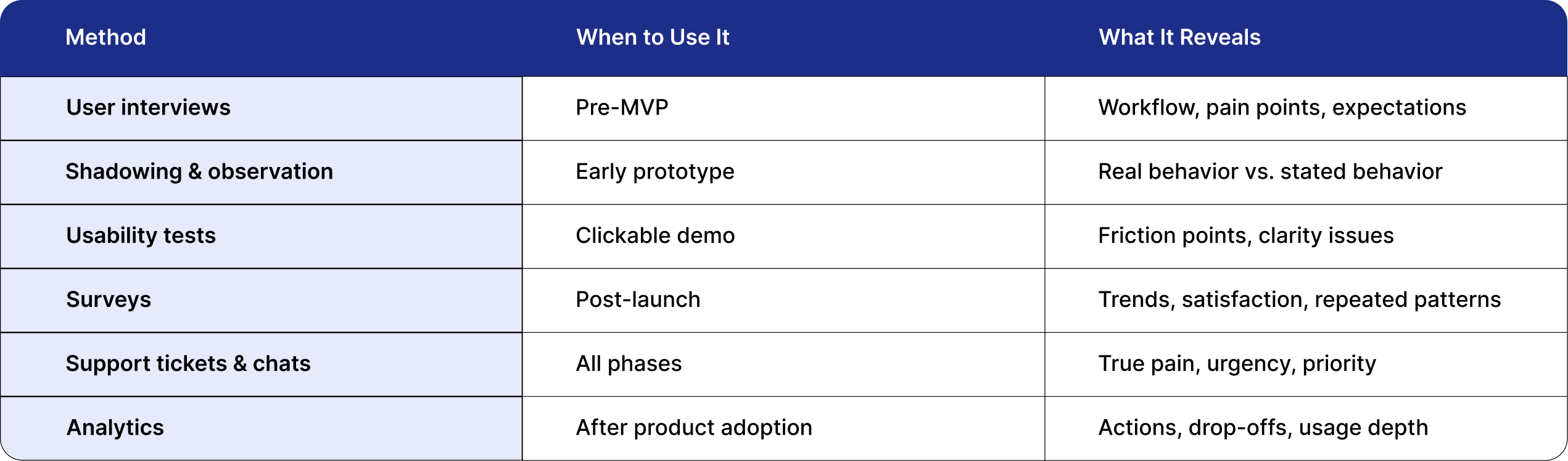
These steps build a foundation for decisions rooted in real-world patterns.
Where Your Real Customer Insights Live
Your users gather in predictable places:
- Reddit threads
- Slack and Discord groups
- Substack comments
- LinkedIn discussions
Spend one week listening. Highlight repeated frustrations. That becomes your roadmap.
- Reddit threads
- Slack and Discord groups
- Substack comments
- LinkedIn discussions
Spend one week listening. Highlight repeated frustrations. That becomes your roadmap.
Keep Customers in the Room—Always
Leave a chair empty in every meeting.
Name the customer on it.
Ask: “Would they use this?”
This simple discipline prevents founder-centered decisions.
Name the customer on it.
Ask: “Would they use this?”
This simple discipline prevents founder-centered decisions.

How to Break Founder Bias
Founder bias appears when you assume your needs represent the market. The fastest way to break this is to remove yourself from being the “default” user. Stop building software for yourself.
Here are grounded ways to do that.
Here are grounded ways to do that.
Create a named customer profile
Give them a name, a job, a workflow, and a world.
This is similar to leaving an empty chair in meetings representing the user.
This is similar to leaving an empty chair in meetings representing the user.
Stop making decisions without data
If you can’t point to:
- interview notes
- support conversations
- usage analytics
- customer patterns
…the decision is based on your preference, not theirs.
- interview notes
- support conversations
- usage analytics
- customer patterns
…the decision is based on your preference, not theirs.
Test before you build
Low-fidelity prototypes protect engineering time and budget. A simple clickable flow reveals more than three weeks of development.
Run weekly customer conversations
Five conversations a week change everything.
Patterns start showing up.
The roadmap becomes about them, not you.
Patterns start showing up.
The roadmap becomes about them, not you.
Invest in Channels That You Control
LinkedIn, your email list, your site—these are your home base.
Map your content to customer triggers:
Map your content to customer triggers:
Weekly content rhythm
Monday: industry pain
Wednesday: customer insight
Friday: progress story
This builds credibility long before you start selling.
Wednesday: customer insight
Friday: progress story
This builds credibility long before you start selling.
A Framework to Build the Right Product
Here is a clear, grounded approach we’ve used across years of engineering and product work.
The 7P1R Framework for Building the Right Software
This framework helps teams stop building software for themselves and evaluate what actually sets them apart.
- Product: What problem do customers repeat the most?
- Price: Does your pricing fit the real value, or your assumption of value?
- Place: Where are your customers already searching for solutions?
- Promotion: Which channels show real traction instead of vanity engagement?
- People: What specific expertise gives you an advantage in solving their problem?
- Process: How do you deliver differently in a way customers actually feel?
- Proud: What matters to you that competitors ignore? → Values shape positioning.
- Relations: How do you support users beyond the product features?
This pulls you away from building what you like and toward building what users stay for.
- Product: What problem do customers repeat the most?
- Price: Does your pricing fit the real value, or your assumption of value?
- Place: Where are your customers already searching for solutions?
- Promotion: Which channels show real traction instead of vanity engagement?
- People: What specific expertise gives you an advantage in solving their problem?
- Process: How do you deliver differently in a way customers actually feel?
- Proud: What matters to you that competitors ignore? → Values shape positioning.
- Relations: How do you support users beyond the product features?
This pulls you away from building what you like and toward building what users stay for.
How to Prioritize Features the Right Way
Feature priority becomes simpler when you focus on user value while you build product instead of founder opinion.
1. Track repeated pain
If three customers say it, the market likely wants it.
2. Evaluate severity
A problem that blocks workflow outranks a problem that slows it down.
3. Measure frequency
Daily pains rank higher than monthly irritations.
4. Remove ego
If the feature excites you but confuses customers, pause it.
5. Run small tests first
Prototype → test → revise → build.
It saves money and time.
1. Track repeated pain
If three customers say it, the market likely wants it.
2. Evaluate severity
A problem that blocks workflow outranks a problem that slows it down.
3. Measure frequency
Daily pains rank higher than monthly irritations.
4. Remove ego
If the feature excites you but confuses customers, pause it.
5. Run small tests first
Prototype → test → revise → build.
It saves money and time.
Become Your Own Brand Ambassador
You just need to talk about the problems you’re solving and the work behind the scenes. People trust founders who tell the truth. It builds momentum more effectively than ads. This can be done through CAPS.
The CAPS Storytelling Framework
A simple structure for meaningful stories:
- Curiosity: Start from the problem at its worst.
- Accountability: Show how you’ve lived the same struggle.
- Persistency: Explain why existing solutions fall short.
- Surprise: Show the shift that becomes possible.
Great stories help customers understand their own pain in a clearer way.
- Curiosity: Start from the problem at its worst.
- Accountability: Show how you’ve lived the same struggle.
- Persistency: Explain why existing solutions fall short.
- Surprise: Show the shift that becomes possible.
Great stories help customers understand their own pain in a clearer way.
Hiring Your First Marketing Manager
Hire doers. Ask:
“What would you do in week one?”
“Show me something you built yourself.”
“Tell me about a failure and what it taught you.”
“Here are interview notes, what would you post Monday?”
Look for scrappy builders with strong instincts and low ego.
“What would you do in week one?”
“Show me something you built yourself.”
“Tell me about a failure and what it taught you.”
“Here are interview notes, what would you post Monday?”
Look for scrappy builders with strong instincts and low ego.
Conclusion
Founders bring the vision. Customers bring the truth. External teams bring the discipline to align both.
Great products with understanding followed by features. When you stop building software for yourself, you create room for a product the market recognizes instantly. Products succeed when they fit real life.
If you want to build product that reaches adoption faster, saves development cycles, and aligns with genuine
ser behavior, stop building software yourself, start with customer conversations and clear validation
before you write a single line of code. If you want help designing the right product strategy, you can share your idea and we’ll outline a user-first development plan tailored to your market.
FAQs
1. What does “stop building product for yourself” mean?
Stop building software yourself means avoiding assumptions based on your personal workflow and focusing on real customer needs.
2. Why do founders make this mistake?
Because the original idea came from their own problem, and they assume the market feels the same way.
3. How do I validate before building software?
Interview users, observe workflows, collect behavior data, and test prototypes early.
4. How can I avoid building the wrong product?
Use a customer-first framework, run weekly conversations, and prioritize features based on real patterns.
5. What tools help in early validation?
Analytics platforms, interview templates, surveys, session recordings, and prototype tools.

Written by / Author
Manasi Maheshwari
Found this useful? Share With
Top blogs
Most Read Blogs
Wits Innovation Lab is where creativity and innovation flourish. We provide the tools you need to come up with innovative solutions for today's businesses, big or small.
© 2026 Wits Innovation Lab, All rights reserved
Crafted in-house by WIL’s talented minds