

Published - 6 months ago | 6 min read
How Teachers Are Using AI in Education Inside Real Classrooms
Teachers are using AI in education in everyday classroom work to manage planning, writing, and preparation tasks that usually take up personal time. The tools help move work forward faster, especially when teachers are stretched thin.
This matters because teaching includes far more than instruction. Lesson planning, adapting materials, creating assessments, and writing feedback often happen after school hours. AI in education reduces the effort needed to get from an idea to something usable.
When it is working properly, AI in education stays in a supporting role. Teachers decide what enters the classroom, what gets changed, and what never gets used. The technology assists the process without shaping the instruction.
This matters because teaching includes far more than instruction. Lesson planning, adapting materials, creating assessments, and writing feedback often happen after school hours. AI in education reduces the effort needed to get from an idea to something usable.
When it is working properly, AI in education stays in a supporting role. Teachers decide what enters the classroom, what gets changed, and what never gets used. The technology assists the process without shaping the instruction.
What AI in education means inside a classroom
AI in education refers to software tools that assist teachers with planning, writing, organizing, and adapting instructional materials. In simple terms, it means systems that can generate drafts, examples, summaries, or alternative explanations when prompted.
In classrooms where these tools are used regularly, teachers do not treat them as authoritative sources. They are used as starting points. A teacher may ask for a lesson outline, a rewritten explanation, or a set of practice questions, then review and adjust the result.
This approach matters because classroom decisions depend on context. Student ability, pacing, classroom dynamics, and local curriculum standards cannot be inferred accurately by software alone. Teachers who benefit from AI in education understand this and keep judgment firmly human.
The value of these tools comes from speed and flexibility. They shorten preparation time and reduce repetition without removing instructional responsibility.
In classrooms where these tools are used regularly, teachers do not treat them as authoritative sources. They are used as starting points. A teacher may ask for a lesson outline, a rewritten explanation, or a set of practice questions, then review and adjust the result.
This approach matters because classroom decisions depend on context. Student ability, pacing, classroom dynamics, and local curriculum standards cannot be inferred accurately by software alone. Teachers who benefit from AI in education understand this and keep judgment firmly human.
The value of these tools comes from speed and flexibility. They shorten preparation time and reduce repetition without removing instructional responsibility.
1. Using AI to plan lessons and units
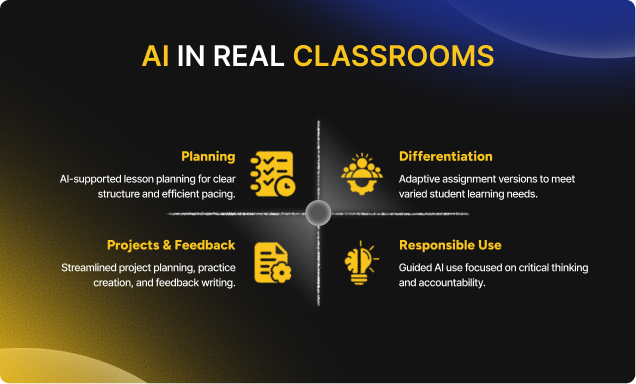
Lesson planning is one of the most common ways teachers use AI in education. Teachers rely on it to outline lessons, organize activities, and structure units around limited class time.
A typical use starts with a prompt that includes the topic, grade level, and time available. The AI generates a lesson flow that includes an opening activity, core instruction, and checks for understanding. Teachers then revise the material to match their class.
This approach helps because planning fatigue often comes from starting with nothing. A rough structure gives teachers something concrete to react to and improve.
Teachers who get consistent value from classroom AI tools focus their requests on structure rather than polished language. They ask for pacing suggestions, common misconceptions, or discussion questions. That produces material that adapts more easily.
In practice, teachers still rewrite explanations and examples. The tool accelerates the setup, not the teaching.
A typical use starts with a prompt that includes the topic, grade level, and time available. The AI generates a lesson flow that includes an opening activity, core instruction, and checks for understanding. Teachers then revise the material to match their class.
This approach helps because planning fatigue often comes from starting with nothing. A rough structure gives teachers something concrete to react to and improve.
Teachers who get consistent value from classroom AI tools focus their requests on structure rather than polished language. They ask for pacing suggestions, common misconceptions, or discussion questions. That produces material that adapts more easily.
In practice, teachers still rewrite explanations and examples. The tool accelerates the setup, not the teaching.
2. Using AI to create multiple versions of assignments
Creating different versions of the same assignment is time-consuming. AI in education helps teachers generate variations that support different learning needs.
Common uses include:
- Simplified instructions for students who need extra support
- Sentence starters for writing tasks
- Extended or deeper prompts for advanced learners
- Adjusted reading levels for the same core content
Teachers review these versions carefully. AI-generated adaptations can sometimes remove complexity along with difficulty. Teachers who use classroom AI regularly check whether the learning goal remains intact.
This approach allows teachers to respond to diverse classrooms without rewriting entire assignments from scratch. It also helps reduce inequities caused by time constraints.
At the school level, shared edtech practices make this easier. When teams use similar prompts and review standards, quality stays consistent.
Common uses include:
- Simplified instructions for students who need extra support
- Sentence starters for writing tasks
- Extended or deeper prompts for advanced learners
- Adjusted reading levels for the same core content
Teachers review these versions carefully. AI-generated adaptations can sometimes remove complexity along with difficulty. Teachers who use classroom AI regularly check whether the learning goal remains intact.
This approach allows teachers to respond to diverse classrooms without rewriting entire assignments from scratch. It also helps reduce inequities caused by time constraints.
At the school level, shared edtech practices make this easier. When teams use similar prompts and review standards, quality stays consistent.
3. Using AI to design long-running classroom projects
Some teachers use AI in education to design projects that run alongside regular instruction instead of appearing only at the end of a unit.
These projects evolve as students learn new concepts. AI helps teachers plan the sequence, define milestones, and connect daily lessons to a larger task.
In math and logic-based subjects, teachers use AI to help structure scenarios that require reasoning rather than memorization. In humanities classes, AI supports project frameworks that emphasize decision-making, reflection, and synthesis.
The teacher remains responsible for assessment and guidance. AI assists with planning and structure, not evaluation.
This approach helps students see how individual lessons connect to broader ideas. It also reduces the planning burden that often discourages project-based learning.
These projects evolve as students learn new concepts. AI helps teachers plan the sequence, define milestones, and connect daily lessons to a larger task.
In math and logic-based subjects, teachers use AI to help structure scenarios that require reasoning rather than memorization. In humanities classes, AI supports project frameworks that emphasize decision-making, reflection, and synthesis.
The teacher remains responsible for assessment and guidance. AI assists with planning and structure, not evaluation.
This approach helps students see how individual lessons connect to broader ideas. It also reduces the planning burden that often discourages project-based learning.
4. Using AI to support feedback and written communication
Writing feedback takes time and emotional energy. AI in education often supports teachers by improving clarity and consistency in written communication.
Teachers use it to:
- Rewrite feedback so it is clear and neutral
- Translate the rubric language into student-friendly terms
- Create reusable feedback comment sets
- Summarize common issues across assignments
Teachers determine performance levels themselves. AI assists with phrasing and organization. This separation keeps evaluation grounded in professional judgment.
AI in education also supports communication outside grading. Teachers use it to draft parent emails, progress updates, and learning plans that require careful tone.
Clear communication reduces misunderstandings and follow-up questions. Teachers often report that this saves time later in the term.
Teachers use it to:
- Rewrite feedback so it is clear and neutral
- Translate the rubric language into student-friendly terms
- Create reusable feedback comment sets
- Summarize common issues across assignments
Teachers determine performance levels themselves. AI assists with phrasing and organization. This separation keeps evaluation grounded in professional judgment.
AI in education also supports communication outside grading. Teachers use it to draft parent emails, progress updates, and learning plans that require careful tone.
Clear communication reduces misunderstandings and follow-up questions. Teachers often report that this saves time later in the term.
5. Using AI to generate reading and practice materials
Teachers use AI in education to create additional practice material when students need more exposure to a concept.
Examples include:
- Short reading passages on specific topics
- Practice questions aligned to current lessons
- Examples that match a particular reading level
- Story-based exercises for engagement
Teachers review these materials for accuracy and appropriateness. AI output sometimes includes language that does not match a student's ability or local context.
This use is especially common in literacy support and language learning. Teachers generate content quickly, then adjust vocabulary and structure as needed.
The benefit comes from flexibility. Teachers can respond to student needs without waiting for external resources.
Examples include:
- Short reading passages on specific topics
- Practice questions aligned to current lessons
- Examples that match a particular reading level
- Story-based exercises for engagement
Teachers review these materials for accuracy and appropriateness. AI output sometimes includes language that does not match a student's ability or local context.
This use is especially common in literacy support and language learning. Teachers generate content quickly, then adjust vocabulary and structure as needed.
The benefit comes from flexibility. Teachers can respond to student needs without waiting for external resources.
6. Teaching students how to work with AI responsibly
Some teachers explicitly teach students how to interact with AI as part of classroom learning. Classroom AI becomes part of the assignment rather than a hidden shortcut.
Students may be asked to:
- Analyze AI responses for errors
- Revise weak AI drafts using the course material
- Reflect on how instructions affected output
- Explain what the AI misunderstood
A common classroom routine includes generating an AI response, identifying problems, revising the content, and submitting both versions.
This approach builds reasoning and accountability. Students learn that AI output depends heavily on clarity, context, and verification.
Teachers who take this approach report fewer issues with misuse because expectations are visible.
Students may be asked to:
- Analyze AI responses for errors
- Revise weak AI drafts using the course material
- Reflect on how instructions affected output
- Explain what the AI misunderstood
A common classroom routine includes generating an AI response, identifying problems, revising the content, and submitting both versions.
This approach builds reasoning and accountability. Students learn that AI output depends heavily on clarity, context, and verification.
Teachers who take this approach report fewer issues with misuse because expectations are visible.
Comparison table: classroom uses and risk levels

Why policy and structure are now unavoidable
AI use in classrooms is moving faster than formal guidance. Only 10% of schools and universities currently have an official framework for the use of AI.
This gap creates inconsistency. Teachers make decisions individually, often without clear rules around data, accuracy, or acceptable use. Some proceed cautiously. Others avoid AI entirely. Both approaches carry risk.
Schools that see stable outcomes tend to provide:
- Clear boundaries on student data
- Approved tools for common tasks
- Simple guidance that teachers can remember
Policy does not need to be complex. It needs to be clear, realistic, and aligned with classroom practice.
Without structure, AI use becomes uneven. With structure, AI in education becomes predictable and manageable.
This gap creates inconsistency. Teachers make decisions individually, often without clear rules around data, accuracy, or acceptable use. Some proceed cautiously. Others avoid AI entirely. Both approaches carry risk.
Schools that see stable outcomes tend to provide:
- Clear boundaries on student data
- Approved tools for common tasks
- Simple guidance that teachers can remember
Policy does not need to be complex. It needs to be clear, realistic, and aligned with classroom practice.
Without structure, AI use becomes uneven. With structure, AI in education becomes predictable and manageable.
Conclusion
AI in education is helping teachers save time without replacing professional judgment. In real classrooms, it supports planning, differentiation, feedback, and material creation while teachers remain fully responsible for what students see and learn. The most effective use comes from clear boundaries and simple structures that keep AI in a supporting role. When used intentionally, AI reduces preparation load and allows teachers to focus more on instruction and student learning.
FAQs
1. What is AI in education used for by teachers?
Teachers use it for planning, differentiation, feedback, projects, and communication.
2. Does classroom AI replace teaching?
No. Teachers make instructional decisions and review all material.
3. Is edtech with AI safe for students?
Safety depends on tool approval and clear data rules.
4. How do teachers prevent misuse?
By designing assignments that require process, reflection, and verification.
5. Where should schools start with AI in education?
With one approved tool and clear guidance for teachers.

Written by / Author
Manasi Maheshwari
Found this useful? Share With
Top blogs
Most Read Blogs
Wits Innovation Lab is where creativity and innovation flourish. We provide the tools you need to come up with innovative solutions for today's businesses, big or small.
© 2026 Wits Innovation Lab, All rights reserved
Crafted in-house by WIL’s talented minds