
The boardroom conversations have shifted. Where executives once debated whether to adopt artificial intelligence in human resources, they now discuss which systems deliver measurable returns. AI in HR 2026 represents a quiet revolution, one happening in recruitment calls at 3 AM, performance reviews conducted across twelve time zones, and compensation decisions affecting thousands of employees.
The numbers tell a compelling story. According to the 28th edition of the HR Tech HR Systems Survey from Sapient Insights Group, 31% of organizations now use AI within HR processes, up from 24% the previous year. The more striking finding reveals that 80% of HR professionals use AI tools personally for work tasks. This gap between organizational adoption and individual usage signals where the industry is heading.
The numbers tell a compelling story. According to the 28th edition of the HR Tech HR Systems Survey from Sapient Insights Group, 31% of organizations now use AI within HR processes, up from 24% the previous year. The more striking finding reveals that 80% of HR professionals use AI tools personally for work tasks. This gap between organizational adoption and individual usage signals where the industry is heading.
The Invisible Infrastructure
Walk into any modern HR department, and you might miss the transformation entirely. The same professionals sit at their desks, conducting interviews and reviewing resumes. Yet beneath this familiar surface, AI in HR systems has become an indispensable partners:
Midnight Processing: AI handles application reviews while teams sleep, ensuring candidates receive responses within hours rather than weeks
Predictive Alerts: Systems identify flight risks before managers notice warning signs, giving organizations time to intervene
Benefits Optimization: Algorithms predict which compensation packages will retain top performers based on individual preferences and market dynamics
Pattern Recognition: AI analyzes why turnover spikes in certain departments during specific months, uncovering trends invisible to human observation
This silent partner approach defines the current moment. HR automation trends have moved beyond chatbots answering basic questions. Today's systems participate in strategic decisions, analyzing patterns humans simply cannot perceive at scale. A multinational corporation might use AI to understand complex workforce dynamics across regions, or why particular job descriptions attract candidates who stay 7 years versus 7 months.
Midnight Processing: AI handles application reviews while teams sleep, ensuring candidates receive responses within hours rather than weeks
Predictive Alerts: Systems identify flight risks before managers notice warning signs, giving organizations time to intervene
Benefits Optimization: Algorithms predict which compensation packages will retain top performers based on individual preferences and market dynamics
Pattern Recognition: AI analyzes why turnover spikes in certain departments during specific months, uncovering trends invisible to human observation
This silent partner approach defines the current moment. HR automation trends have moved beyond chatbots answering basic questions. Today's systems participate in strategic decisions, analyzing patterns humans simply cannot perceive at scale. A multinational corporation might use AI to understand complex workforce dynamics across regions, or why particular job descriptions attract candidates who stay 7 years versus 7 months.
Talent Acquisition Reimagined
The recruitment landscape has undergone its most significant shift since online job boards emerged decades ago. AI for talent acquisition now means systems that read between the lines of resumes, identifying transferable skills that traditional keyword matching would miss entirely.
Consider a software engineer who spent three years in customer support. Previous systems would flag this as irrelevant experience. Modern AI recognizes that customer-facing technical roles develop communication skills, problem-solving under pressure, and empathy- qualities that distinguish good developers from exceptional ones.
These systems have learned to decode career narratives. They identify high performers based on trajectory rather than credentials alone. Someone who progressed from intern to senior analyst in three years signals different qualities than someone who held the same title for a decade. Both paths have value; AI for talent acquisition helps match each pattern to roles where those qualities matter most.
The measurable impact includes:
- 40% reduction in time-to-hire while simultaneously improving candidate quality
- Automated pre-screening that processes applications overnight
- Cross-timezone interview scheduling that eliminates coordination delays
- Tailored interview questions generated based on each candidate's unique background
- Skills matching that identifies transferable capabilities traditional systems overlook
Consider a software engineer who spent three years in customer support. Previous systems would flag this as irrelevant experience. Modern AI recognizes that customer-facing technical roles develop communication skills, problem-solving under pressure, and empathy- qualities that distinguish good developers from exceptional ones.
These systems have learned to decode career narratives. They identify high performers based on trajectory rather than credentials alone. Someone who progressed from intern to senior analyst in three years signals different qualities than someone who held the same title for a decade. Both paths have value; AI for talent acquisition helps match each pattern to roles where those qualities matter most.
The measurable impact includes:
- 40% reduction in time-to-hire while simultaneously improving candidate quality
- Automated pre-screening that processes applications overnight
- Cross-timezone interview scheduling that eliminates coordination delays
- Tailored interview questions generated based on each candidate's unique background
- Skills matching that identifies transferable capabilities traditional systems overlook
Analytics That Actually Predict
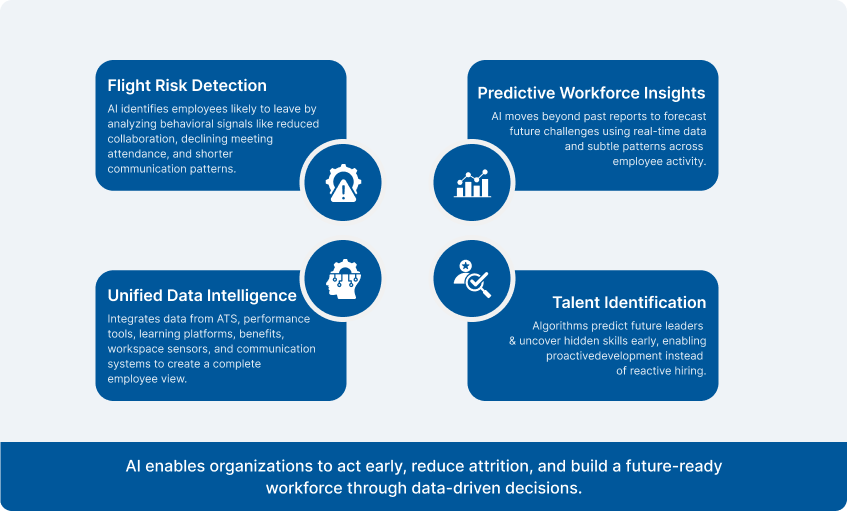
People analytics tools have evolved beyond generating reports on last quarter's turnover. They forecast tomorrow's challenges using today's subtle signals.
Leading organizations now deploy predictive models of AI in HR processess that identify flight risk with surprising accuracy. These systems analyze factors ranging from recent project assignments to email communication patterns. When a top performer starts exhibiting behaviors associated with departure, reduced collaboration, declining meeting attendance, shorter email responses, the system alerts their manager while suggesting intervention strategies.
Modern analytics platforms integrate diverse data sources:
- Applicant tracking systems
- Performance management tools
- Learning and development platforms
- Benefits enrollment data
- Workspace utilization sensors
- Communication pattern analysis
This creates a comprehensive view of the employee experience, impossible to assemble manually.
Some applications of AI in HR border on prescient. Algorithms can predict which employees will excel in leadership roles years before traditional succession planning would identify them. They spot nascent skills in team members who've barely recognized those abilities themselves. People analytics tools allow organizations to develop talent proactively rather than scrambling when key positions open.
Leading organizations now deploy predictive models of AI in HR processess that identify flight risk with surprising accuracy. These systems analyze factors ranging from recent project assignments to email communication patterns. When a top performer starts exhibiting behaviors associated with departure, reduced collaboration, declining meeting attendance, shorter email responses, the system alerts their manager while suggesting intervention strategies.
Modern analytics platforms integrate diverse data sources:
- Applicant tracking systems
- Performance management tools
- Learning and development platforms
- Benefits enrollment data
- Workspace utilization sensors
- Communication pattern analysis
This creates a comprehensive view of the employee experience, impossible to assemble manually.
Some applications of AI in HR border on prescient. Algorithms can predict which employees will excel in leadership roles years before traditional succession planning would identify them. They spot nascent skills in team members who've barely recognized those abilities themselves. People analytics tools allow organizations to develop talent proactively rather than scrambling when key positions open.
The Compensation Intelligence Layer
Salary decisions once relied heavily on market surveys and gut instinct. AI has introduced precision to this imprecise art. Systems now analyze real-time compensation data across industries, adjusting recommendations based on location, skills, experience, and current market dynamics.
These tools help organizations balance competing priorities: remaining competitive while managing costs, ensuring internal equity while accounting for external market forces, and retaining critical talent without setting unsustainable precedents.
The sophistication extends to benefits optimization. AI systems analyze which perks employees actually value versus those that consume budget without driving satisfaction. They might reveal that your expensive gym membership partnership sees minimal usage, while flexible work arrangements cost little yet drive significant retention.
These tools help organizations balance competing priorities: remaining competitive while managing costs, ensuring internal equity while accounting for external market forces, and retaining critical talent without setting unsustainable precedents.
The sophistication extends to benefits optimization. AI systems analyze which perks employees actually value versus those that consume budget without driving satisfaction. They might reveal that your expensive gym membership partnership sees minimal usage, while flexible work arrangements cost little yet drive significant retention.
Learning That Adapts
Corporate training has long suffered from a one-size-fits-all approach. AI and HR automation trends enable personalization at enterprise scale. Learning platforms now assess each employee's current skills, learning style, career aspirations, and knowledge gaps, then curate development paths accordingly.
These systems track progress in real-time, adjusting difficulty and pacing based on comprehension. When someone struggles with a concept, the AI offers alternative explanations or additional practice. When someone masters material quickly, it accelerates their progression.
The implications for workforce development prove substantial. Organizations can upskill employees rapidly as business needs evolve, rather than hiring externally for every new requirement. This preserves institutional knowledge while building capabilities for emerging challenges.
These systems track progress in real-time, adjusting difficulty and pacing based on comprehension. When someone struggles with a concept, the AI offers alternative explanations or additional practice. When someone masters material quickly, it accelerates their progression.
The implications for workforce development prove substantial. Organizations can upskill employees rapidly as business needs evolve, rather than hiring externally for every new requirement. This preserves institutional knowledge while building capabilities for emerging challenges.
The Human Element Amplified
Perhaps the most significant shift involves how AI frees HR professionals to focus on genuinely human work. Automation handles repetitive tasks, allowing practitioners to invest time in relationship building, complex problem-solving, and strategic thinking.
Tasks AI now handles autonomously:
- Resume screening and initial candidate assessment
- Interview scheduling across multiple time zones
- Routine paperwork processing
- Answering frequently asked policy questions
- Benefits enrollment coordination
- Compliance documentation
Time redirected to high-value activities:
- Meaningful conversations with candidates exploring cultural fit
- Counseling employees through complex career decisions
- Analyzing organizational dynamics and proposing strategic solutions
- Building relationships that drive retention and engagement
- Creative problem-solving for unique workforce challenges
This elevation of the profession addresses a longstanding challenge. HR teams frequently found themselves overwhelmed by administrative work, unable to deliver the strategic value they knew they could provide. AI serves as a capable assistant that handles logistics while humans focus on judgment, empathy, and creativity.
Tasks AI now handles autonomously:
- Resume screening and initial candidate assessment
- Interview scheduling across multiple time zones
- Routine paperwork processing
- Answering frequently asked policy questions
- Benefits enrollment coordination
- Compliance documentation
Time redirected to high-value activities:
- Meaningful conversations with candidates exploring cultural fit
- Counseling employees through complex career decisions
- Analyzing organizational dynamics and proposing strategic solutions
- Building relationships that drive retention and engagement
- Creative problem-solving for unique workforce challenges
This elevation of the profession addresses a longstanding challenge. HR teams frequently found themselves overwhelmed by administrative work, unable to deliver the strategic value they knew they could provide. AI serves as a capable assistant that handles logistics while humans focus on judgment, empathy, and creativity.
The Ethics Architecture
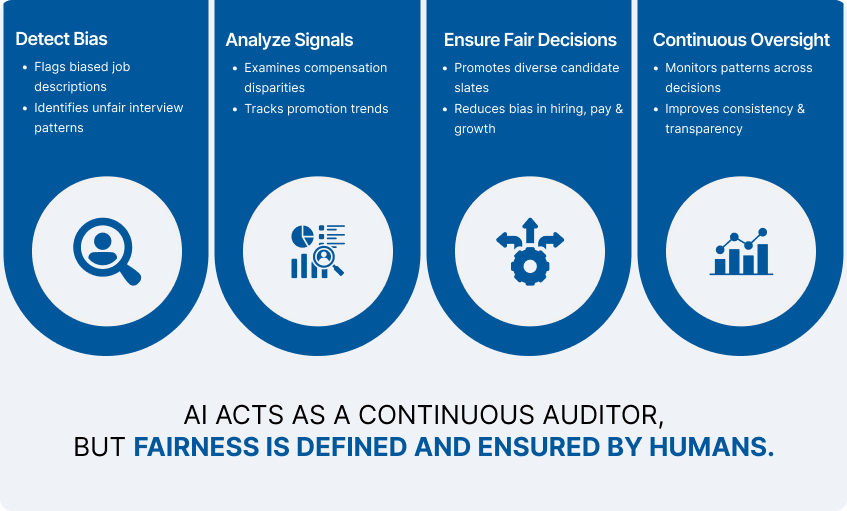
Sophisticated organizations have embedded fairness considerations directly into their AI systems. These tools actively work to reduce bias in hiring, promotion, and compensation decisions.
AI-driven fairness mechanisms:
- Identifying when job descriptions inadvertently discourage certain demographic groups from applying
- Flagging interview processes that systematically disadvantage particular candidates
- Highlighting compensation disparities that lack performance-based justification
- Ensuring diverse candidate slates reach decision-makers
- Monitoring promotion patterns for unintended bias
This approach introduces a level of consistency and transparency difficult to achieve through purely human processes. The AI technology in HR serves as a continuous auditor, examining decisions for patterns that might escape individual notice.
Organizations must remember that AI remains a tool deployed by humans who define fairness and monitor outcomes. The responsibility for equitable treatment stays firmly in human hands, with AI providing the analytical support to identify and correct systemic issues.
AI-driven fairness mechanisms:
- Identifying when job descriptions inadvertently discourage certain demographic groups from applying
- Flagging interview processes that systematically disadvantage particular candidates
- Highlighting compensation disparities that lack performance-based justification
- Ensuring diverse candidate slates reach decision-makers
- Monitoring promotion patterns for unintended bias
This approach introduces a level of consistency and transparency difficult to achieve through purely human processes. The AI technology in HR serves as a continuous auditor, examining decisions for patterns that might escape individual notice.
Organizations must remember that AI remains a tool deployed by humans who define fairness and monitor outcomes. The responsibility for equitable treatment stays firmly in human hands, with AI providing the analytical support to identify and correct systemic issues.
Looking Through the Windshield
The trajectory points toward even tighter integration. Projections indicate that 80% of organizations will use AI for workforce planning, while 70% of employees expect personalized AI-driven career development plans. The future of work is being written today, and AI is at the heart of it.
Emerging capabilities on the horizon:
- Real-time coaching for managers during difficult conversations
- Organizational restructures suggested based on collaboration patterns
- Cultural fit predictions with remarkable accuracy
- Personalized career pathing at enterprise scale
- Automated succession planning that identifies future leaders years in advance
The partnership between human intelligence and artificial intelligence will deepen as both sides develop capabilities that complement rather than compete.
Characteristics of organizations thriving in this environment:
- Investment in change management alongside technology implementation
- Maintained human oversight of all AI-driven decisions
- Transparent communication about how algorithms influence people decisions
- Continuous auditing of systems for unintended consequences
- Commitment to ethical AI deployment and fairness monitoring
Emerging capabilities on the horizon:
- Real-time coaching for managers during difficult conversations
- Organizational restructures suggested based on collaboration patterns
- Cultural fit predictions with remarkable accuracy
- Personalized career pathing at enterprise scale
- Automated succession planning that identifies future leaders years in advance
The partnership between human intelligence and artificial intelligence will deepen as both sides develop capabilities that complement rather than compete.
Characteristics of organizations thriving in this environment:
- Investment in change management alongside technology implementation
- Maintained human oversight of all AI-driven decisions
- Transparent communication about how algorithms influence people decisions
- Continuous auditing of systems for unintended consequences
- Commitment to ethical AI deployment and fairness monitoring
The Practical Reality
For HR leaders evaluating these AI in HR, several principles emerge from early adopters:
Implementation best practices:
- Start with clearly defined problems rather than implementing technology for its own sake
- Ensure data infrastructure can support advanced analytics before deploying AI systems
- Invest heavily in training teams to work alongside AI effectively
- Build feedback loops that continuously improve system performance
- Pilot programs in specific departments before enterprise-wide rollout
- Measure outcomes against baseline metrics to demonstrate value
The future of HR technology lies in augmentation rather than replacement. AI handles volume, speed, and pattern recognition. Humans provide judgment, empathy, and strategic vision. Together, they create HR functions more effective than either could achieve alone.
This quiet revolution proceeds whether we acknowledge it or our colleagues down the hall have already integrated AI into their workflow, making faster decisions with better outcomes. The question facing every organization shifts from whether to adopt these tools to how quickly they can implement them effectively.
The transformation of HR through artificial intelligence represents one of the most significant shifts in how organizations manage their most valuable asset, their people. Those who embrace future of HR technology thoughtfully will build workforces more engaged, productive, and aligned with business objectives than ever before possible.
Implementation best practices:
- Start with clearly defined problems rather than implementing technology for its own sake
- Ensure data infrastructure can support advanced analytics before deploying AI systems
- Invest heavily in training teams to work alongside AI effectively
- Build feedback loops that continuously improve system performance
- Pilot programs in specific departments before enterprise-wide rollout
- Measure outcomes against baseline metrics to demonstrate value
The future of HR technology lies in augmentation rather than replacement. AI handles volume, speed, and pattern recognition. Humans provide judgment, empathy, and strategic vision. Together, they create HR functions more effective than either could achieve alone.
This quiet revolution proceeds whether we acknowledge it or our colleagues down the hall have already integrated AI into their workflow, making faster decisions with better outcomes. The question facing every organization shifts from whether to adopt these tools to how quickly they can implement them effectively.
The transformation of HR through artificial intelligence represents one of the most significant shifts in how organizations manage their most valuable asset, their people. Those who embrace future of HR technology thoughtfully will build workforces more engaged, productive, and aligned with business objectives than ever before possible.
Conclusion
Assessing a candidate's skills is an essential part of the hiring process. By using various assessment methods, you can gain a complete picture of the candidate's abilities, potential fit with the company culture, and potential for success in the role.
Whether you use technical tests, simulations, work samples, behavioral interviews, peer interviews, reference checks, personality assessments, or assessment centers, it's important to use a combination of methods to gain a complete picture of the candidate.
By assessing a candidate's skills, you can make better hiring decisions that will benefit your business, your team, and the candidate. At Wits Innovation Lab, we have cracked the code on finding the perfect candidates for your team. We've tried and tested our IT Staffing services, which assess the skills of potential hires to bring you the cream of the crop. Take advantage of our services today and get the best people to take your business to the next level. Don't settle for mediocre talent - trust Wits Innovation Lab to deliver the best of the best.
Whether you use technical tests, simulations, work samples, behavioral interviews, peer interviews, reference checks, personality assessments, or assessment centers, it's important to use a combination of methods to gain a complete picture of the candidate.
By assessing a candidate's skills, you can make better hiring decisions that will benefit your business, your team, and the candidate. At Wits Innovation Lab, we have cracked the code on finding the perfect candidates for your team. We've tried and tested our IT Staffing services, which assess the skills of potential hires to bring you the cream of the crop. Take advantage of our services today and get the best people to take your business to the next level. Don't settle for mediocre talent - trust Wits Innovation Lab to deliver the best of the best.

Written by / Author
Manasi Maheshwari
Found this useful? Share With
Top blogs
Most Read Blogs
Wits Innovation Lab is where creativity and innovation flourish. We provide the tools you need to come up with innovative solutions for today's businesses, big or small.
© 2026 Wits Innovation Lab, All rights reserved
Crafted in-house by WIL’s talented minds