
Published - 3 months ago | 8 min read
Google Gemma 4 Review: Is This the Open Source AI Model That Changes Everything?
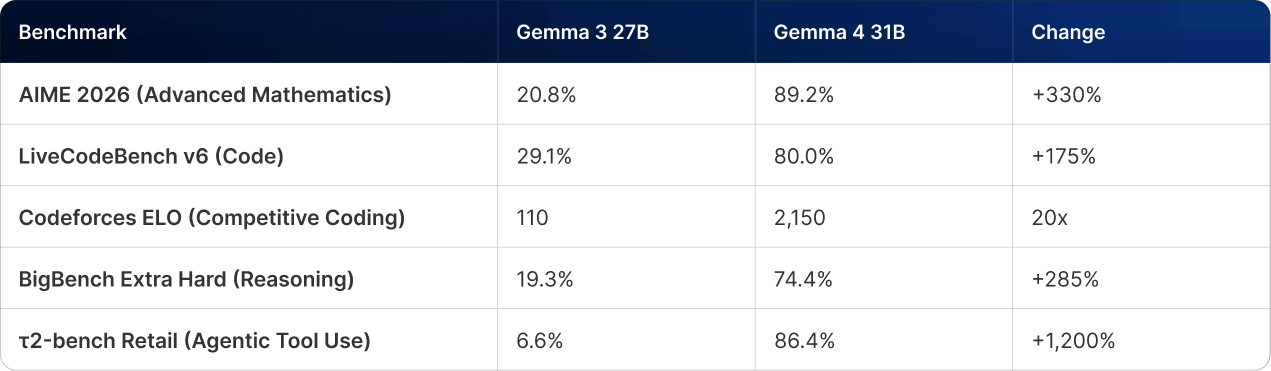
On April 2, 2026, Google DeepMind released a 31-billion-parameter open model that scored 89.2% on AIME 2026 mathematics benchmark. The prior generation, Gemma 3 27B, scored 20.8% on that same test. That gap, from 20.8% to 89.2% in a single generation, is not an incremental update. It is a signal that the AI capability ceiling for self-hosted, commercially deployable models has moved somewhere most teams had not anticipated.
Google Gemma 4 open source arrives at a moment when the open model space is genuinely crowded. Llama 4, Qwen 3.5, DeepSeek V3, and Kimi K2.5 are all credible options. What separates Gemma 4 is not one exceptional score but a consistent top-tier showing across math, code, reasoning, and agentic benchmarks, packaged inside a clean Apache 2.0 license, at sizes that run on hardware most development teams already own.
Google Gemma 4 open source arrives at a moment when the open model space is genuinely crowded. Llama 4, Qwen 3.5, DeepSeek V3, and Kimi K2.5 are all credible options. What separates Gemma 4 is not one exceptional score but a consistent top-tier showing across math, code, reasoning, and agentic benchmarks, packaged inside a clean Apache 2.0 license, at sizes that run on hardware most development teams already own.
What Google Gemma 4 Open Source Actually Is
Google Gemma 4 open source is a family of four open-weight AI models built directly from the research and architecture underlying Gemini 3, Google's flagship proprietary model. "Open-weight" is the precise term: the model weights are publicly downloadable, commercially usable, and deployable on your own infrastructure without API dependency or per-token billing.
The family spans an unusually wide hardware range. The smallest variant runs on a smartphone. The largest competes with closed-source models from OpenAI and Anthropic at a fraction of the inference cost. All four models support text, images, and video natively. The edge variants additionally support audio, handling speech recognition without a separate ASR layer.
This is the first Gemma release under Apache 2.0 licensing. Prior generations shipped under a custom Gemma Terms of Use agreement that enterprise legal and procurement teams routinely blocked. The switch to Apache 2.0 removes that friction entirely. Teams can deploy commercially, fine-tune, redistribute, and integrate Gemma 4 into products without a custom license review.
The Gemma ecosystem has accumulated over 400 million downloads and more than 100,000 community-built variants since its first launch, a network Google calls the Gemmaverse. Gemma 4 inherits the tooling, integration support, and community knowledge base immediately on release.
The family spans an unusually wide hardware range. The smallest variant runs on a smartphone. The largest competes with closed-source models from OpenAI and Anthropic at a fraction of the inference cost. All four models support text, images, and video natively. The edge variants additionally support audio, handling speech recognition without a separate ASR layer.
This is the first Gemma release under Apache 2.0 licensing. Prior generations shipped under a custom Gemma Terms of Use agreement that enterprise legal and procurement teams routinely blocked. The switch to Apache 2.0 removes that friction entirely. Teams can deploy commercially, fine-tune, redistribute, and integrate Gemma 4 into products without a custom license review.
The Gemma ecosystem has accumulated over 400 million downloads and more than 100,000 community-built variants since its first launch, a network Google calls the Gemmaverse. Gemma 4 inherits the tooling, integration support, and community knowledge base immediately on release.
Four Models, Four Deployment Realities
Gemma 4 comes in four versatile sizes: E2B and E4B for edge devices, a 26B Mixture of Experts (MoE) model, and a 31B Dense model for workstations. The naming carries technical meaning worth understanding before selecting a variant.
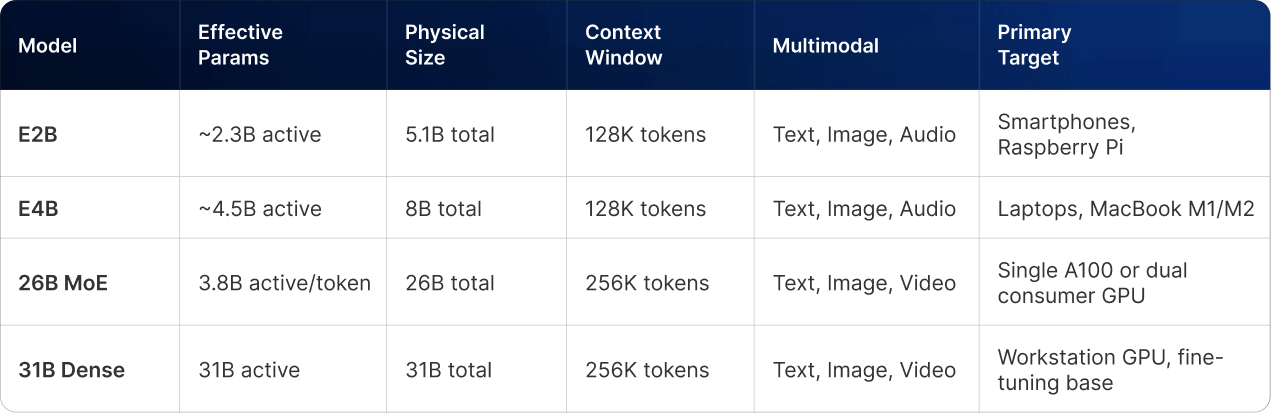
The "E" prefix on the edge models stands for Effective parameters. E2B and E4B use Per-Layer Embeddings (PLE), a technique that feeds a secondary embedding signal into every decoder layer. The models physically contain 5.1B and 8B parameters, respectively, but PLE reduces compute and memory to the equivalent of 2.3B and 4.5B, meaning they run on phones while punching well above their weight class.
The 26B MoE uses 128 expert sub-networks but activates only a subset totaling roughly 3.8B parameters per token. The practical result is workstation-grade reasoning quality at edge-model inference cost.
The 26B MoE uses 128 expert sub-networks but activates only a subset totaling roughly 3.8B parameters per token. The practical result is workstation-grade reasoning quality at edge-model inference cost.
The Benchmark Numbers That Changed the Conversation
Benchmark tables are easy to produce and easy to dismiss. The Gemma 4 numbers are worth examining because the gaps between generations are large enough to represent qualitative capability changes, not marginal gains.
Gemma 4 vs. Gemma 3: Generation-over-Generation
Sources: Arena AI leaderboard · Google DeepMind model cards · Labellerr, April 2026
The τ2-bench result deserves specific attention. Agentic workflows, where the model calls tools, executes steps, and handles errors, depend on this capability. The jump from 6.6% to 86.4% is the most telling result for real-world deployment. A model that could barely function as an autonomous agent in Gemma 3 is now a credible agentic runtime in Gemma 4.
The τ2-bench result deserves specific attention. Agentic workflows, where the model calls tools, executes steps, and handles errors, depend on this capability. The jump from 6.6% to 86.4% is the most telling result for real-world deployment. A model that could barely function as an autonomous agent in Gemma 3 is now a credible agentic runtime in Gemma 4.
Gemma 4 31B vs. Current Competition

Sources: Tech-Insider, April 2026 · StartupHub.ai, April 2026
The 26B MoE holds the number six spot on the Arena AI text leaderboard while activating only 3.8B parameters per forward pass, making it the most parameter-efficient reasoning engine available.
The 26B MoE holds the number six spot on the Arena AI text leaderboard while activating only 3.8B parameters per forward pass, making it the most parameter-efficient reasoning engine available.
The Architecture Behind the Numbers
The performance gap between Gemma 3 and Gemma 4 traces to several structural architecture decisions, not simply more compute.
1. Per-Layer Embeddings (PLE) feed a distinct embedding signal at every decoder layer rather than only at the input. The effect is that each layer receives context-enriched representations, allowing smaller models to reason with a richness that their parameter count alone would not predict.
2. Mixture-of-Experts routing in the 26B model applies specifically to the feed-forward network (FFN) layers, where most model parameters accumulate. The 26B model uses 128 small experts per FFN layer, with 8 activated per token plus one always-on shared expert, while attention layers remain dense. Sparse activation across FFN layers is where MoE delivers its efficiency dividend.
3. Reasoning mode gives the model a dedicated internal thinking budget before committing to a final answer. The larger variants can generate over 4,000 tokens of explicit chain-of-thought reasoning, improving reliability on complex multi-step problems.
4. Alternating local/global attention with dual RoPE handles the extended context windows. Edge models reach 128K tokens; the 26B and 31B reach 256K, approximately 200 pages of continuous text within a single inference window.
1. Per-Layer Embeddings (PLE) feed a distinct embedding signal at every decoder layer rather than only at the input. The effect is that each layer receives context-enriched representations, allowing smaller models to reason with a richness that their parameter count alone would not predict.
2. Mixture-of-Experts routing in the 26B model applies specifically to the feed-forward network (FFN) layers, where most model parameters accumulate. The 26B model uses 128 small experts per FFN layer, with 8 activated per token plus one always-on shared expert, while attention layers remain dense. Sparse activation across FFN layers is where MoE delivers its efficiency dividend.
3. Reasoning mode gives the model a dedicated internal thinking budget before committing to a final answer. The larger variants can generate over 4,000 tokens of explicit chain-of-thought reasoning, improving reliability on complex multi-step problems.
4. Alternating local/global attention with dual RoPE handles the extended context windows. Edge models reach 128K tokens; the 26B and 31B reach 256K, approximately 200 pages of continuous text within a single inference window.
Apache 2.0 and What It Means for Builders
The license change from Gemma's custom terms to Apache 2.0 is not a technical feature. It is a legal status change that removes a class of enterprise risk.
Under the prior Gemma Terms of Use, procurement and legal teams in large organizations could block deployment on several grounds: restrictions on use in products competing with Google, caps on user scale, and clauses that required negotiation before commercial rollout. None of that applies to Apache 2.0.
Enterprise adoption is arguably as significant as the capability improvements. Legal and procurement teams that blocked Gemma 3 on licensing grounds have no equivalent objection to Apache 2.0. The model can be deployed commercially, fine-tuned, redistributed, and integrated into products without the legal overhead of a custom license review.
For regulated industries specifically, this matters at the infrastructure level. Companies in healthcare, finance, and legal can deploy Gemma 4 on-premises, keeping all data within their infrastructure with no API calls, no data leaving the building, and no vendor lock-in. The Apache 2.0 license makes that deployment legally clean by default, not by exception.
Under the prior Gemma Terms of Use, procurement and legal teams in large organizations could block deployment on several grounds: restrictions on use in products competing with Google, caps on user scale, and clauses that required negotiation before commercial rollout. None of that applies to Apache 2.0.
Enterprise adoption is arguably as significant as the capability improvements. Legal and procurement teams that blocked Gemma 3 on licensing grounds have no equivalent objection to Apache 2.0. The model can be deployed commercially, fine-tuned, redistributed, and integrated into products without the legal overhead of a custom license review.
For regulated industries specifically, this matters at the infrastructure level. Companies in healthcare, finance, and legal can deploy Gemma 4 on-premises, keeping all data within their infrastructure with no API calls, no data leaving the building, and no vendor lock-in. The Apache 2.0 license makes that deployment legally clean by default, not by exception.
Where Google Gemma 4 Open Source Fits in Production
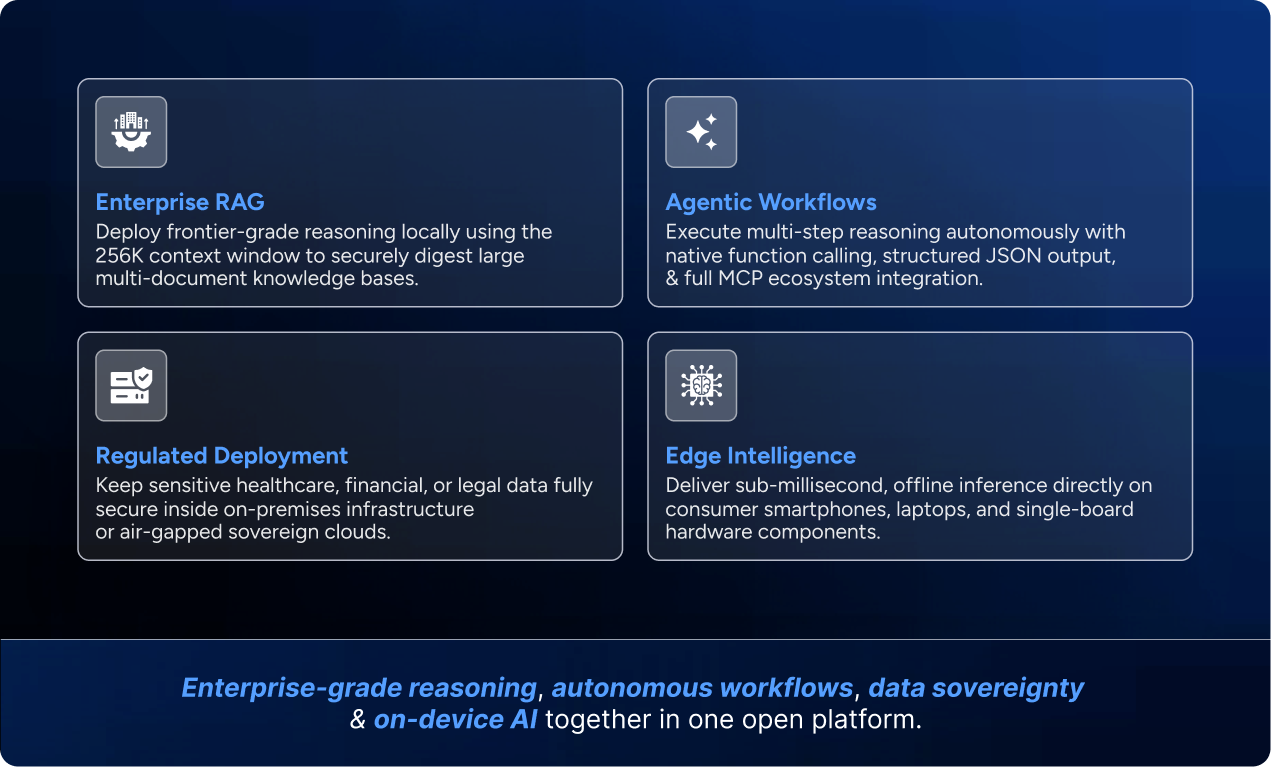
Enterprise RAG and Internal Knowledge Bases
The 31B Dense gives the reasoning quality RAG synthesis needs. It scores 85.2% on MMLU Pro and ranks third on the Arena AI leaderboard, delivering frontier-grade reasoning on a self-hosted model. Teams can serve it via vLLM with an OpenAI-compatible endpoint and deploy across Google Cloud with sovereign cloud options for full data control.
The Apache 2.0 license means teams ship without negotiating usage-tier restrictions. The 256K context window handles large document batches within a single prompt, reducing retrieval complexity.
The Apache 2.0 license means teams ship without negotiating usage-tier restrictions. The 256K context window handles large document batches within a single prompt, reducing retrieval complexity.
Agentic Workflow Development
The τ2-bench result of 86.4% reflects a model that can reliably call tools, recover from errors, and execute multi-step workflows without manual intervention at each step. Gemma 4 supports native function calling and structured JSON output, making integration into existing agentic pipelines straightforward.
Anthropic's Model Context Protocol has become the de facto standard for connecting AI to tools. Any model with function calling support, including Gemma 4, participates in MCP ecosystems. Google extended this with WebMCP for browser-native agents at I/O 2026.
Anthropic's Model Context Protocol has become the de facto standard for connecting AI to tools. Any model with function calling support, including Gemma 4, participates in MCP ecosystems. Google extended this with WebMCP for browser-native agents at I/O 2026.
Regulated Industry Deployment
Healthcare, legal, and financial services teams face a common constraint: sensitive data cannot leave organizational infrastructure. Google Gemma 4 open source resolves this structurally. The 31B Dense handles complex document analysis, contract review, and clinical note synthesis on local hardware. Google Cloud's Sovereign Cloud offerings include public cloud with Data Boundary, Google Cloud Dedicated (such as S3NS in France), and Google Distributed Cloud for air-gapped and on-premises deployments.
Edge and Device-Level Intelligence
The E2B and E4B edge models run completely offline on smartphones, Raspberry Pi boards, and Jetson Nano devices with near-zero latency, operating up to four times faster than previous Gemma versions. The Pixel team worked closely with Qualcomm and MediaTek to optimize the edge models for mobile chipsets.
The E4B's LiveCodeBench v6 score of 80% is notable because that score matches what Gemma 3 27B achieved on the AIME mathematics benchmark. A model that fits in a developer's laptop now codes at the level of last year's large server-side model.
The E4B's LiveCodeBench v6 score of 80% is notable because that score matches what Gemma 3 27B achieved on the AIME mathematics benchmark. A model that fits in a developer's laptop now codes at the level of last year's large server-side model.
What You Should Know Before Deploying
Deploying Google Gemma 4 open source with accurate expectations requires knowing the model's defined boundaries alongside its capabilities.
- Training cutoff: January 2025. The model has no real-time knowledge without tool integration. RAG architectures or function calling to live data sources resolve this for most production use cases.
- Audio scope: Speech recognition and audio understanding are supported. Music and non-speech audio are outside the current scope.
- Video length: Video input is capped at 60 seconds across all variants.
- MoE inference speed: Community benchmarks measured the 26B MoE producing roughly 11 tokens per second on single-GPU setups. For latency-sensitive applications, the E4B is the faster option, and the 31B Dense is the more consistent option for quality-critical tasks.
- Reasoning mode timing: Enabled by default on most variants, reasoning mode adds 30 to 75 seconds per response as the model works through its internal chain-of-thought. Developers building low-latency features should configure accordingly.
- Training cutoff: January 2025. The model has no real-time knowledge without tool integration. RAG architectures or function calling to live data sources resolve this for most production use cases.
- Audio scope: Speech recognition and audio understanding are supported. Music and non-speech audio are outside the current scope.
- Video length: Video input is capped at 60 seconds across all variants.
- MoE inference speed: Community benchmarks measured the 26B MoE producing roughly 11 tokens per second on single-GPU setups. For latency-sensitive applications, the E4B is the faster option, and the 31B Dense is the more consistent option for quality-critical tasks.
- Reasoning mode timing: Enabled by default on most variants, reasoning mode adds 30 to 75 seconds per response as the model works through its internal chain-of-thought. Developers building low-latency features should configure accordingly.
Conclusion
The answer depends on what "best" requires for a specific deployment. For math and competitive coding, Gemma 4 leads the open model field by a substantial margin. For agentic use cases, its τ2-bench result of 86.4% puts it ahead of Llama 4, DeepSeek V4, and GPT variants on that benchmark. For hardware flexibility, no current open model family spans from a Raspberry Pi to a single-GPU workstation while maintaining competitive performance at every size tier.
The 26B A4B reportedly outperforms Qwen 3.5 397B in user preference and coding. Vision and audio benchmarks confirm strong out-of-the-box multimodal performance without specialized fine-tuning.
The Arena AI preference scores add a layer beyond accuracy metrics. Humans consistently preferred Gemma 4's responses over competitors even when automated benchmark scores were nearly identical. The 31B's Arena AI ELO of 1,452 placed it above models with far more parameters. Something about how Gemma 4 structures its answers resonates with human evaluators in ways that accuracy metrics alone do not capture.
Google Gemma 4 open source is the clearest answer Google has produced for developers who want a capable, commercially deployable, infrastructure-sovereign AI that does not trade performance for openness. The AIME mathematics score and the agentic benchmarks confirm that this is a model family operating at a different level than prior open-weight releases. The Apache 2.0 license confirms that teams can build on it without the legal friction that held back adoption of earlier versions.
For teams evaluating the best open source AI model 2026 across capability, hardware range, licensing cleanliness, and deployment flexibility, Google Gemma 4 open source is the benchmark against which other releases will now be measured.
The 26B A4B reportedly outperforms Qwen 3.5 397B in user preference and coding. Vision and audio benchmarks confirm strong out-of-the-box multimodal performance without specialized fine-tuning.
The Arena AI preference scores add a layer beyond accuracy metrics. Humans consistently preferred Gemma 4's responses over competitors even when automated benchmark scores were nearly identical. The 31B's Arena AI ELO of 1,452 placed it above models with far more parameters. Something about how Gemma 4 structures its answers resonates with human evaluators in ways that accuracy metrics alone do not capture.
Google Gemma 4 open source is the clearest answer Google has produced for developers who want a capable, commercially deployable, infrastructure-sovereign AI that does not trade performance for openness. The AIME mathematics score and the agentic benchmarks confirm that this is a model family operating at a different level than prior open-weight releases. The Apache 2.0 license confirms that teams can build on it without the legal friction that held back adoption of earlier versions.
For teams evaluating the best open source AI model 2026 across capability, hardware range, licensing cleanliness, and deployment flexibility, Google Gemma 4 open source is the benchmark against which other releases will now be measured.

Written by / Author
Manasi Maheshwari
Found this useful? Share With
Top blogs
Most Read Blogs
Wits Innovation Lab is where creativity and innovation flourish. We provide the tools you need to come up with innovative solutions for today's businesses, big or small.
© 2026 Wits Innovation Lab, All rights reserved
Crafted in-house by WIL’s talented minds