
Published - 4 months ago | 6 min read
Google AI Overviews Crushed Organic CTR by 60%: Here's How to Survive in 2026
If your traffic charts look healthy on impressions but your clicks keep sliding, you are not imagining things. Google AI Overviews are quietly killing SEO as we knew it, and the numbers behind the shift are hard to ignore. Pages that still rank where they always have are now bleeding clicks because a machine-written summary sits above them and answers the question before anyone scrolls.
This post breaks down exactly what happened, why it happened, and the SEO strategy after AI Overviews that actually keeps your business visible in 2026.
This post breaks down exactly what happened, why it happened, and the SEO strategy after AI Overviews that actually keeps your business visible in 2026.
What the Data Actually Shows
The headline is brutal. Pages that still rank exactly where they always have are now losing clicks because a machine-written summary sits above them and answers the query before anyone scrolls. Google itself frames AI Overviews as a way to let Search do the legwork and surface quick answers right on the results page, which is exactly why fewer searchers scroll down to click.
The scale of the shift shows up in the click data. Backlinko's analysis of 4 million Google search results found the average position 1 result earns roughly 27.6% of clicks, and the top spot still pulls about ten times the clicks of position 10. The blue links did not move. The interface around them did.
That is the trap most teams fall into. Your rankings can improve while your clicks collapse, because ranking position no longer means what it used to.
The scale of the shift shows up in the click data. Backlinko's analysis of 4 million Google search results found the average position 1 result earns roughly 27.6% of clicks, and the top spot still pulls about ten times the clicks of position 10. The blue links did not move. The interface around them did.
That is the trap most teams fall into. Your rankings can improve while your clicks collapse, because ranking position no longer means what it used to.
Why This Is Happening
Understanding the mechanism matters because it tells you where to fight back. A few forces are stacking on top of each other.
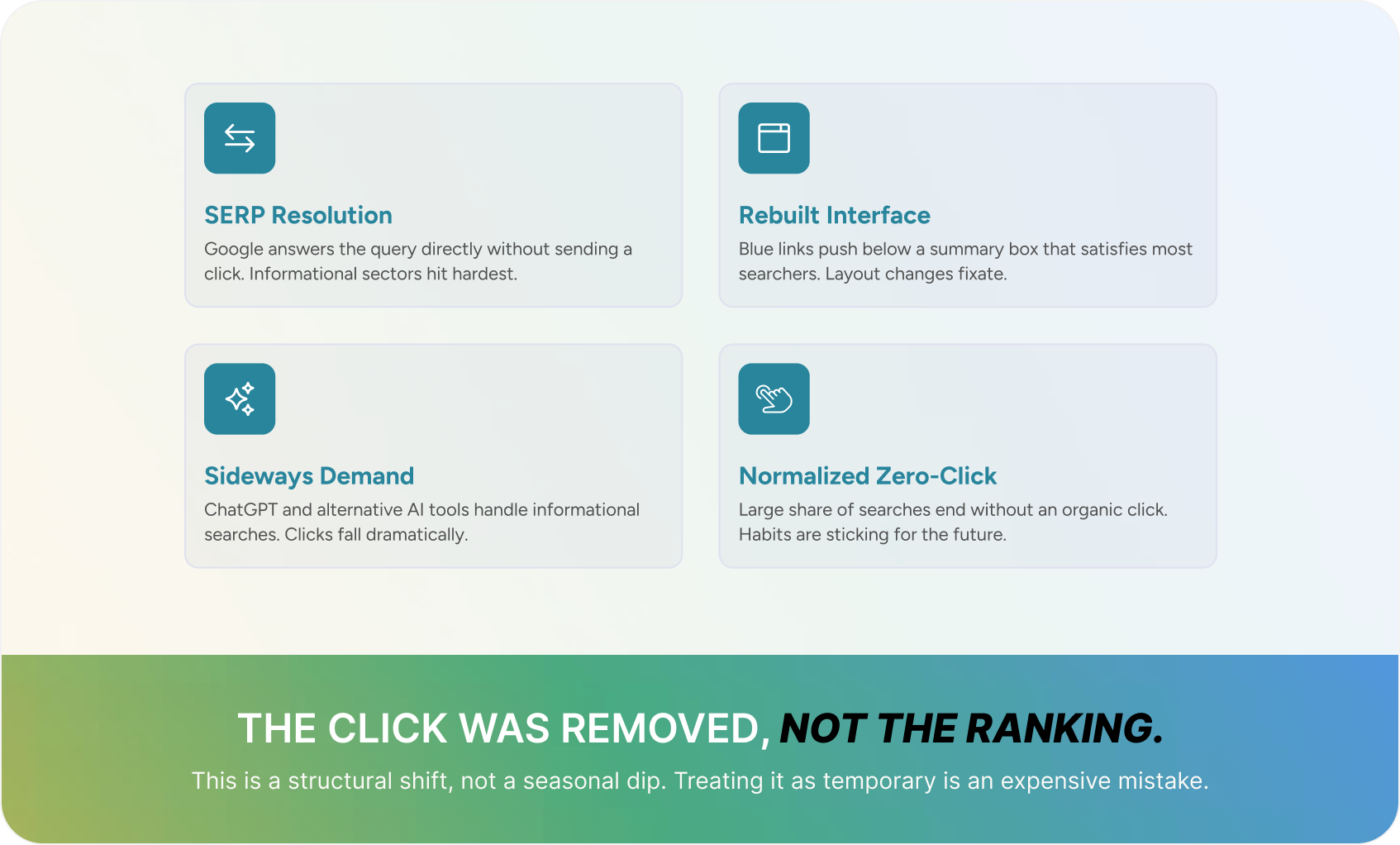
1. Google answers the query in the SERP. Informational sectors like health, parenting, and home improvement get hit hardest because Google can resolve the question directly without sending a click anywhere.
2. The interface was rebuilt around your listing. Your blue link still appears, but it now sits below a summary box that satisfies most searchers. The page changed, not your content.
3. AI search is pulling demand sideways. ChatGPT and similar tools now handle a chunk of the informational searches that used to start on Google, which is why clicks fall even without an AI Overview present.
4. Zero-click behavior is now normal. A large share of US searches end without a single organic click, and that habit is sticking.
The takeaway is simple. This is a structural shift in how search works, not a seasonal dip that bounces back in a few weeks. When people say Google AI Overviews are killing SEO, this is what they mean: the click was removed from the equation, not the ranking. Treating it like a temporary slump is the most expensive mistake you can make right now.
1. Google answers the query in the SERP. Informational sectors like health, parenting, and home improvement get hit hardest because Google can resolve the question directly without sending a click anywhere.
2. The interface was rebuilt around your listing. Your blue link still appears, but it now sits below a summary box that satisfies most searchers. The page changed, not your content.
3. AI search is pulling demand sideways. ChatGPT and similar tools now handle a chunk of the informational searches that used to start on Google, which is why clicks fall even without an AI Overview present.
4. Zero-click behavior is now normal. A large share of US searches end without a single organic click, and that habit is sticking.
The takeaway is simple. This is a structural shift in how search works, not a seasonal dip that bounces back in a few weeks. When people say Google AI Overviews are killing SEO, this is what they mean: the click was removed from the equation, not the ranking. Treating it like a temporary slump is the most expensive mistake you can make right now.
The Survival Playbook for 2026
Here is the part you came for. A smart SEO strategy after AI Overviews is not about chasing the old click numbers. The brands holding steady are not doing anything magical. They are following a tighter, smarter version of fundamentals. Work through these in order.
1. Segment Your Keywords by Intent
Stop looking at one blended CTR number in Search Console. That single line hides two very different problems. Split your keywords into four buckets:
- Informational: The most exposed to AI Overviews. Expect heavy click loss here.
- Commercial: Comparison and review style queries, still valuable but increasingly contested.
- Transactional: People are ready to buy or act, where intent is high, and AI summaries help less.
- Navigational: People looking for a specific brand or page are mostly protected.
Once you segment, you can see which pages are losing clicks to AI Overviews specifically, rather than guessing.
- Informational: The most exposed to AI Overviews. Expect heavy click loss here.
- Commercial: Comparison and review style queries, still valuable but increasingly contested.
- Transactional: People are ready to buy or act, where intent is high, and AI summaries help less.
- Navigational: People looking for a specific brand or page are mostly protected.
Once you segment, you can see which pages are losing clicks to AI Overviews specifically, rather than guessing.
2. Audit Which Queries Trigger AI Overviews
Pull your high-value keywords and check which ones actually show an AI Overview. Then map those against the pages losing clicks. This gives you a priority list instead of a vague sense of doom. Focus your energy where the overlap is highest: strong-value queries that trigger an overview and have falling clicks.
3. Earn Citations Inside the Overview
Being cited inside an AI Overview improves performance compared to being uncited. Google has stated that links included in AI Overviews get more clicks than if the same page had appeared as a traditional listing for that query. So the goal shifts from beating the box to getting quoted by it. To increase your odds:
- Answer the core question clearly and early on the page.
- Use unique data, original research, or specific numbers that the model wants to cite.
- Structure content with clean headings and direct answers that a model can lift.
- Build genuine topical authority so Google trusts your page as a source.
- Answer the core question clearly and early on the page.
- Use unique data, original research, or specific numbers that the model wants to cite.
- Structure content with clean headings and direct answers that a model can lift.
- Build genuine topical authority so Google trusts your page as a source.
4. Rewrite Pages With Unique Value
Generic content that restates what everyone already knows is exactly what an AI Overview replaces. Pages that survive offer something a summary cannot reproduce:
- Proprietary data and benchmarks.
- First-hand experience, testing, and real examples.
- Strong opinion and analysis backed by evidence.
- Tools, calculators, and interactive elements that need a click.
If your page can be fully summarized in two sentences, it will be.
- Proprietary data and benchmarks.
- First-hand experience, testing, and real examples.
- Strong opinion and analysis backed by evidence.
- Tools, calculators, and interactive elements that need a click.
If your page can be fully summarized in two sentences, it will be.
5. Change the Metrics You Report On
Clicks and raw traffic are losing meaning. Visibility and share of voice are taking their place. Start tracking:
- How often do you appear in AI Overviews and AI search answers?
- Branded search volume, which signals real demand.
- Conversion rate from the clicks you do get.
Here is the upside hiding in the data. The clicks that survive often convert better, because users who click after reading a summary are already informed and have higher intent. Fewer visitors, but warmer ones.
- How often do you appear in AI Overviews and AI search answers?
- Branded search volume, which signals real demand.
- Conversion rate from the clicks you do get.
Here is the upside hiding in the data. The clicks that survive often convert better, because users who click after reading a summary are already informed and have higher intent. Fewer visitors, but warmer ones.
6. Build Traffic Google Cannot Take Away
This is the long game, and it is the most important point on this list. Anything that lives entirely on Google's terms can be reduced by Google overnight. Diversify into channels you own or control:
- Email capture: Direct access to your audience with no algorithm in between.
- Community and direct audience: Newsletters, forums, and groups that bring people back.
- Partnerships and PR: Visibility through other trusted sources.
- Rebalanced paid mix: Since paid CTR also drops when AI Overviews dominate, spread budget across organic, paid, email, and partnerships rather than betting everything on one.
- Email capture: Direct access to your audience with no algorithm in between.
- Community and direct audience: Newsletters, forums, and groups that bring people back.
- Partnerships and PR: Visibility through other trusted sources.
- Rebalanced paid mix: Since paid CTR also drops when AI Overviews dominate, spread budget across organic, paid, email, and partnerships rather than betting everything on one.
A Simple Way to Prioritize
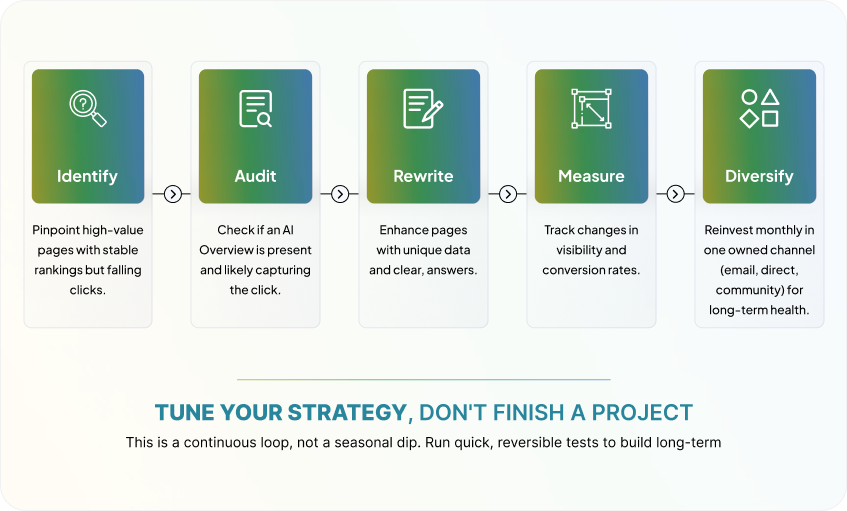
If the list above feels like a lot, run it as a quick weekly loop:
1. Identify the high-value pages losing clicks despite stable rankings.
2. Check whether an AI Overview is the cause for those queries.
3. Rewrite those pages with unique data and clear, citable answers.
4. Measure visibility and conversions, not just clicks.
5. Reinvest in one owned channel every month so you depend less on search.
Small, reversible tests beat one giant overhaul. A durable SEO strategy after AI Overviews treats your search presence like a system you tune, not a project you finish.
1. Identify the high-value pages losing clicks despite stable rankings.
2. Check whether an AI Overview is the cause for those queries.
3. Rewrite those pages with unique data and clear, citable answers.
4. Measure visibility and conversions, not just clicks.
5. Reinvest in one owned channel every month so you depend less on search.
Small, reversible tests beat one giant overhaul. A durable SEO strategy after AI Overviews treats your search presence like a system you tune, not a project you finish.
Is There Any Good News?
Yes, and it is worth ending on. Some early 2026 signals suggest the floor may be steadying for certain segments. That does not restore the old search world, but it does hint that the decline may not drop forever.
There is a strategic reframe too. The fear that Google AI Overviews are killing SEO assumes all traffic is equal, but it is not. AI Overviews handle the shallow, easily answered queries, which were never your best traffic anyway. What remains is deeper, higher-intent demand, and that audience is more likely to buy, subscribe, or come back. If you build for that audience, the shrinking click pool matters less than it looks on a dashboard.
There is a strategic reframe too. The fear that Google AI Overviews are killing SEO assumes all traffic is equal, but it is not. AI Overviews handle the shallow, easily answered queries, which were never your best traffic anyway. What remains is deeper, higher-intent demand, and that audience is more likely to buy, subscribe, or come back. If you build for that audience, the shrinking click pool matters less than it looks on a dashboard.
Conclusion
Google AI Overviews really did crush organic CTR, and pretending otherwise will cost you. The brands that win in 2026 are the ones that accept the new reality fast, segment their keywords, earn citations, publish content a machine cannot copy, and build audiences Google does not control.
Talk of Google AI Overviews killing SEO is only half right. The old playbook is fading, but a sharper SEO strategy after AI Overviews replaces it. Rankings still matter. First-page placement still matters. They just do not carry the weight they once did, because your listing now lives inside a page designed to answer questions before anyone clicks. Adjust your strategy to that reality, focus on value and visibility over raw traffic, and you will not just survive the AI Overview era. You will quietly pull ahead of every competitor still waiting for the old search world to come back.
Talk of Google AI Overviews killing SEO is only half right. The old playbook is fading, but a sharper SEO strategy after AI Overviews replaces it. Rankings still matter. First-page placement still matters. They just do not carry the weight they once did, because your listing now lives inside a page designed to answer questions before anyone clicks. Adjust your strategy to that reality, focus on value and visibility over raw traffic, and you will not just survive the AI Overview era. You will quietly pull ahead of every competitor still waiting for the old search world to come back.

Written by / Author
Manasi Maheshwari
Found this useful? Share With
Top blogs
Most Read Blogs
Wits Innovation Lab is where creativity and innovation flourish. We provide the tools you need to come up with innovative solutions for today's businesses, big or small.
© 2026 Wits Innovation Lab, All rights reserved
Crafted in-house by WIL’s talented minds