

Published - 6 months ago | 7 min read
Build vs Buy AI in 2025: Making the Right Investment Decision
The AI economy is moving faster than any other technology wave in history. In just five years, machine learning models have gone from research projects to the core of business strategy. But with that acceleration comes a very practical question that every technology leader faces: Should you build your own AI system or buy an existing one?
Both options can look attractive depending on where your organization stands. Building gives you control and customization. Buying gets you speed and lower initial costs. Yet beneath those surface benefits lie deeper trade-offs, long-term cost of ownership, technical debt, skill dependency, compliance, and flexibility.
This guide looks beyond the short-term numbers and explores what really drives cost and value when deciding whether to build or buy AI in 2025.
Both options can look attractive depending on where your organization stands. Building gives you control and customization. Buying gets you speed and lower initial costs. Yet beneath those surface benefits lie deeper trade-offs, long-term cost of ownership, technical debt, skill dependency, compliance, and flexibility.
This guide looks beyond the short-term numbers and explores what really drives cost and value when deciding whether to build or buy AI in 2025.
1. Understanding the Financial Equation
Every AI project starts with a budget conversation. The challenge is that most organizations underestimate what it actually costs to sustain AI systems after deployment. The initial invoice may look manageable, but the ongoing expenses often exceed early projections.
Building a custom AI platform involves significant upfront spending. Enterprise implementations can easily run between $100,000 and $500,000 before a single model goes live. More complex systems that train large-scale models with billions of parameters can stretch into millions.
Buying, on the other hand, usually begins with subscription-based pricing. Most off-the-shelf AI tools charge anywhere from $200 to $400 per month per license. That sounds far more affordable, until you factor in usage scaling, support, integration, and compliance costs that add up over time.
The more accurate question is not “how much does it cost to start?” but “how much will it cost to own?”
Analysts estimate that nearly 65% of software expenses occur after deployment, in the form of maintenance, upgrades, and infrastructure. For AI, that figure can be even higher because of data retraining, model drift, and increased compute demand as models grow in complexity.
Building a custom AI platform involves significant upfront spending. Enterprise implementations can easily run between $100,000 and $500,000 before a single model goes live. More complex systems that train large-scale models with billions of parameters can stretch into millions.
Buying, on the other hand, usually begins with subscription-based pricing. Most off-the-shelf AI tools charge anywhere from $200 to $400 per month per license. That sounds far more affordable, until you factor in usage scaling, support, integration, and compliance costs that add up over time.
The more accurate question is not “how much does it cost to start?” but “how much will it cost to own?”
Analysts estimate that nearly 65% of software expenses occur after deployment, in the form of maintenance, upgrades, and infrastructure. For AI, that figure can be even higher because of data retraining, model drift, and increased compute demand as models grow in complexity.
2. The Hidden Layer of Long-Term Costs
Running an AI system is a lifelong exercise. Once deployed, models need retraining, pipelines require monitoring, and infrastructure has to scale with new data. All this introduces what engineers call technical debt, the accumulation of quick fixes, dependencies, and outdated components that make future updates more expensive.
For custom AI builds, maintenance can consume 10–20% of the total AI budget each year. A system that costs $300,000 to develop might require $30,000 to $60,000 annually just to stay current. Compliance frameworks like the EU AI Act or HIPAA audits can add another $10,000 to $100,000 in yearly expenses, depending on your industry.
Off-the-shelf platforms remove some of this burden, but they replace it with a different kind of debt: vendor lock-in. Many organizations discover that moving from one provider to another costs double what they paid initially. The data pipelines, model APIs, and storage formats often remain tied to a vendor’s ecosystem, making switching both technically difficult and financially painful.
For custom AI builds, maintenance can consume 10–20% of the total AI budget each year. A system that costs $300,000 to develop might require $30,000 to $60,000 annually just to stay current. Compliance frameworks like the EU AI Act or HIPAA audits can add another $10,000 to $100,000 in yearly expenses, depending on your industry.
Off-the-shelf platforms remove some of this burden, but they replace it with a different kind of debt: vendor lock-in. Many organizations discover that moving from one provider to another costs double what they paid initially. The data pipelines, model APIs, and storage formats often remain tied to a vendor’s ecosystem, making switching both technically difficult and financially painful.
3. Time-to-Market and Opportunity Cost
Speed matters a lot. A company that deploys AI six months earlier can often capture new customers, automate critical processes, and improve margins before competitors react.
Custom builds tend to take between nine and eighteen months, depending on the complexity of the model and the quality of the data pipeline. Buying pre-built solutions can cut that timeline in half, especially when the use case is well understood, like customer support automation, predictive analytics, or fraud detection.
Yet time-to-market cannot be measured only by development speed. Every delay in production also carries an opportunity cost. Organizations lose productivity, data insights, and competitive positioning. Many AI projects fail not because of technical shortcomings but because they never reach users fast enough to generate business value.
Custom builds tend to take between nine and eighteen months, depending on the complexity of the model and the quality of the data pipeline. Buying pre-built solutions can cut that timeline in half, especially when the use case is well understood, like customer support automation, predictive analytics, or fraud detection.
Yet time-to-market cannot be measured only by development speed. Every delay in production also carries an opportunity cost. Organizations lose productivity, data insights, and competitive positioning. Many AI projects fail not because of technical shortcomings but because they never reach users fast enough to generate business value.
4. Technical Debt: The Quiet Cost Driver
Technical debt in AI systems behaves differently from traditional software. In a standard application, outdated code slows progress. In an AI system, outdated models can lead to wrong predictions, compliance failures, or reputational damage.
The CACE principle, “Changing Anything Changes Everything”, perfectly captures this problem. Once an AI model is in production, adjusting one component often requires updating data pipelines, retraining models, and refactoring integrations. Each modification carries a cost.
Research shows that engineers spend nearly a third of their time resolving technical debt. R&D teams dedicate up to half their effort to maintaining legacy codebases that support older models. That translates directly to lost innovation time.
The key to managing debt is visibility. Teams should track the Technical Debt Ratio (TDR), the proportion of resources spent fixing issues versus building new features. A TDR above 5% signals an unhealthy system that will become more expensive to maintain with each iteration.
The CACE principle, “Changing Anything Changes Everything”, perfectly captures this problem. Once an AI model is in production, adjusting one component often requires updating data pipelines, retraining models, and refactoring integrations. Each modification carries a cost.
Research shows that engineers spend nearly a third of their time resolving technical debt. R&D teams dedicate up to half their effort to maintaining legacy codebases that support older models. That translates directly to lost innovation time.
The key to managing debt is visibility. Teams should track the Technical Debt Ratio (TDR), the proportion of resources spent fixing issues versus building new features. A TDR above 5% signals an unhealthy system that will become more expensive to maintain with each iteration.
5. People, Skills, and Organizational Readiness
Building AI in-house requires more than capital, it requires people who can make it work. Machine learning engineers, data scientists, MLOps specialists, and prompt engineers command salaries that often range from $100,000 to $300,000 per year. Recruiting and retaining them is one of the toughest challenges companies face today.
Roughly a third of organizations report being under-resourced in AI talent. Even with high pay, attrition remains high because specialists move quickly between projects and industries. Each departure resets institutional knowledge, creates documentation gaps, and delays delivery.
Outsourcing helps bridge the gap. External AI consultancies bring domain expertise and established workflows that can shorten project timelines by several months. The trade-off is reduced control over your data and architecture. Most companies adopt a hybrid approach, starting with outside partners and gradually transitioning maintenance to internal teams once they gain confidence.
Building internal capacity is ultimately the only sustainable strategy. Teams that understand the full lifecycle, from data collection to deployment, develop stronger governance, faster iteration, and a deeper sense of ownership.
Roughly a third of organizations report being under-resourced in AI talent. Even with high pay, attrition remains high because specialists move quickly between projects and industries. Each departure resets institutional knowledge, creates documentation gaps, and delays delivery.
Outsourcing helps bridge the gap. External AI consultancies bring domain expertise and established workflows that can shorten project timelines by several months. The trade-off is reduced control over your data and architecture. Most companies adopt a hybrid approach, starting with outside partners and gradually transitioning maintenance to internal teams once they gain confidence.
Building internal capacity is ultimately the only sustainable strategy. Teams that understand the full lifecycle, from data collection to deployment, develop stronger governance, faster iteration, and a deeper sense of ownership.
6. Security and Compliance
Security is often the single biggest differentiator between building and buying AI. A custom system allows you to maintain full control over your data. You decide where it’s stored, who can access it, and how it’s encrypted. That level of control is crucial in sectors like finance, healthcare, and defense.
When you buy an AI service, security becomes a shared responsibility. Vendors typically manage the infrastructure, but the client remains responsible for data handling and access control. Misunderstandings in this division often lead to breaches or compliance failures.
The average global data breach cost in 2024 reached $4.88 million, and AI systems can amplify those risks if they process sensitive or proprietary data. Third-party platforms may include hidden data-sharing clauses buried in their terms of service, creating additional exposure.
Compliance adds another layer of complexity. Regulations like the GDPR and the EU AI Act now require companies to classify AI systems by risk category and maintain detailed documentation of model behavior. Failure to comply can lead to fines up to 7% of global turnover. For many companies, that risk alone justifies keeping critical AI systems in-house.
When you buy an AI service, security becomes a shared responsibility. Vendors typically manage the infrastructure, but the client remains responsible for data handling and access control. Misunderstandings in this division often lead to breaches or compliance failures.
The average global data breach cost in 2024 reached $4.88 million, and AI systems can amplify those risks if they process sensitive or proprietary data. Third-party platforms may include hidden data-sharing clauses buried in their terms of service, creating additional exposure.
Compliance adds another layer of complexity. Regulations like the GDPR and the EU AI Act now require companies to classify AI systems by risk category and maintain detailed documentation of model behavior. Failure to comply can lead to fines up to 7% of global turnover. For many companies, that risk alone justifies keeping critical AI systems in-house.
7. Comparing The Two Paths
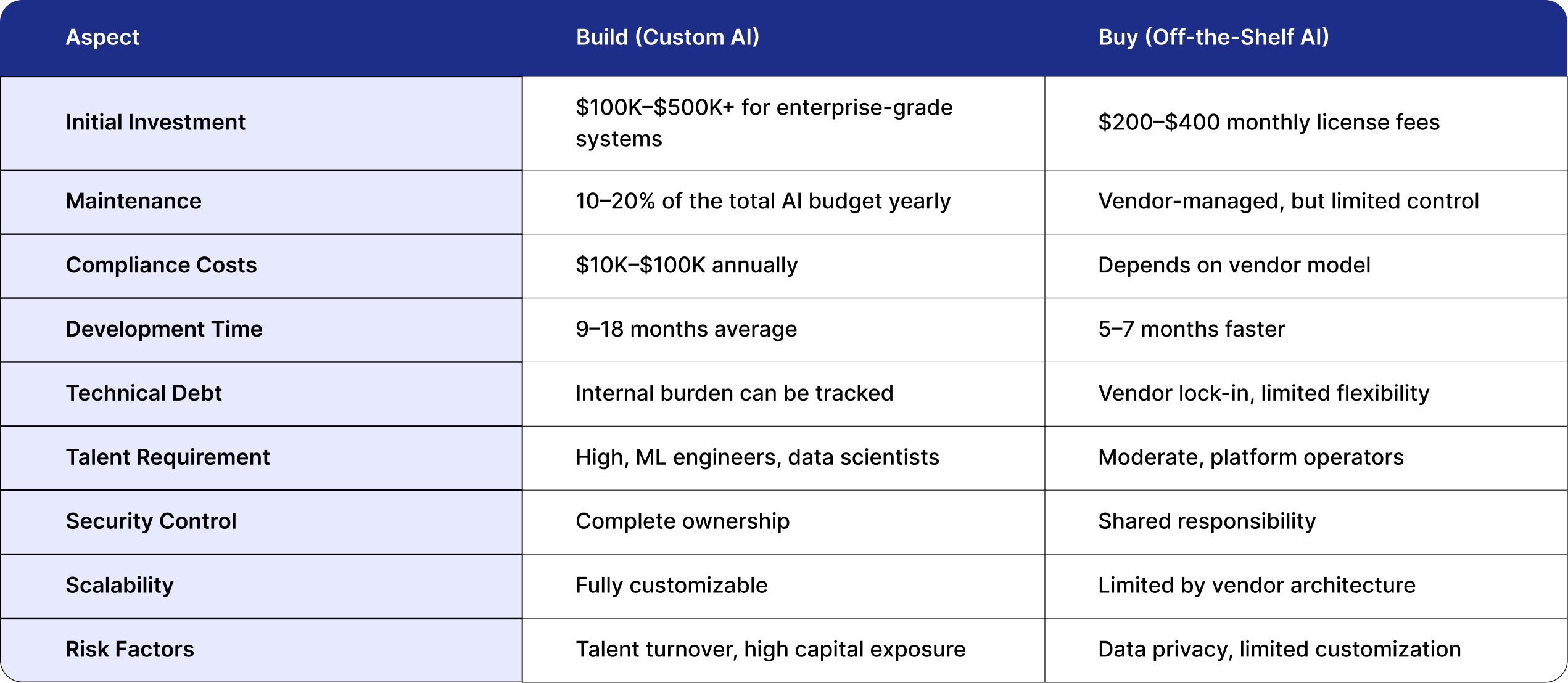
The table highlights the essence of the choice. Building grants full control and long-term flexibility, but demands investment and expertise. Buying accelerates deployment but can limit innovation and expose you to vendor dependency.
8. Evaluating Long-Term Value
When done properly, custom AI can create a lasting competitive advantage. You own the IP, control the data, and decide how to evolve the system. Over time, the total cost of ownership may decline as internal teams learn to optimize infrastructure and automate workflows.
Buying off-the-shelf AI makes sense when the use case is generic, such as chatbots, recommendation systems, or predictive analytics. These solutions bring proven algorithms that can be quickly integrated and refined. The trade-off is that competitors can buy the same capability, limiting differentiation.
In reality, most organizations will end up combining both. They might purchase a foundational AI platform but develop proprietary layers for personalization, risk scoring, or workflow automation. This hybrid approach allows for fast adoption without sacrificing strategic control.
Buying off-the-shelf AI makes sense when the use case is generic, such as chatbots, recommendation systems, or predictive analytics. These solutions bring proven algorithms that can be quickly integrated and refined. The trade-off is that competitors can buy the same capability, limiting differentiation.
In reality, most organizations will end up combining both. They might purchase a foundational AI platform but develop proprietary layers for personalization, risk scoring, or workflow automation. This hybrid approach allows for fast adoption without sacrificing strategic control.
9. Making the Strategic Decision
Choosing between building and buying AI should never rely on intuition. The decision must consider the organization’s financial health, risk appetite, and strategic timeline.
Here’s a practical checklist that many technology leaders use:
1. Define your business objectives clearly. What problem will AI solve, and how will success be measured?
2. Assess your data maturity. Without reliable data pipelines, any AI project, build or buy, will fail.
3. Evaluate internal talent readiness. Do you have the skills to support custom development and long-term maintenance?
4. Calculate total cost of ownership. Include compute, compliance, and retraining expenses.
5. Assess vendor reliability. Review their track record for uptime, transparency, and data protection.
6. Plan for flexibility. Ensure your choice allows future integration with new models and APIs.
The goal is not to pick a side permanently but to choose what fits your organization’s current stage and roadmap. Over time, as AI ecosystems evolve, you may find yourself rebalancing that decision.
Here’s a practical checklist that many technology leaders use:
1. Define your business objectives clearly. What problem will AI solve, and how will success be measured?
2. Assess your data maturity. Without reliable data pipelines, any AI project, build or buy, will fail.
3. Evaluate internal talent readiness. Do you have the skills to support custom development and long-term maintenance?
4. Calculate total cost of ownership. Include compute, compliance, and retraining expenses.
5. Assess vendor reliability. Review their track record for uptime, transparency, and data protection.
6. Plan for flexibility. Ensure your choice allows future integration with new models and APIs.
The goal is not to pick a side permanently but to choose what fits your organization’s current stage and roadmap. Over time, as AI ecosystems evolve, you may find yourself rebalancing that decision.
10. The Future of Build vs Buy AI
By 2025, the AI market will exceed half a trillion dollars in value. Yet the biggest winners will not be those who build the most models or buy the most licenses. They will be the ones who manage their technology like an evolving portfolio, balancing control, cost, and innovation.
Smaller companies may start with off-the-shelf AI to move quickly. As they scale, they’ll bring critical components in-house to reduce dependency and strengthen IP. Enterprises may continue to build custom solutions for strategic functions but integrate external APIs for less critical workloads.
What matters most is agility. The ability to adapt your AI strategy as technologies mature will define financial outcomes far more than any initial build vs buy choice.
Smaller companies may start with off-the-shelf AI to move quickly. As they scale, they’ll bring critical components in-house to reduce dependency and strengthen IP. Enterprises may continue to build custom solutions for strategic functions but integrate external APIs for less critical workloads.
What matters most is agility. The ability to adapt your AI strategy as technologies mature will define financial outcomes far more than any initial build vs buy choice.
Conclusion
The build vs buy debate is not about choosing a side, it’s about understanding your organization’s capacity to sustain what you choose. Building delivers control and differentiation but requires patience, capital, and talent. Buying delivers speed and simplicity but often limits customization and long-term savings. A balanced strategy often delivers the best results. Start fast with existing tools, learn from real data, and then invest in custom development where it creates measurable business value. That approach minimizes risk, accelerates results, and prepares your organization for the next wave of AI evolution.

Written by / Author
Manasi Maheshwari
Found this useful? Share With
Top blogs
Most Read Blogs
Wits Innovation Lab is where creativity and innovation flourish. We provide the tools you need to come up with innovative solutions for today's businesses, big or small.
© 2026 Wits Innovation Lab, All rights reserved
Crafted in-house by WIL’s talented minds