

Published - 9 months ago | 8 min read
AI in Healthcare: The 2026 Guide to Engineering the "Agentic" Hospital
The narrative around Artificial Intelligence in healthcare has fundamentally shifted. In 2026, we are no longer discussing potential; we are discussing infrastructure. According to the American Hospital Association, while 83% of healthcare organizations are piloting generative AI, fewer than 10% have invested in the infrastructure needed for enterprise-wide deployment.
Without decisive action, health care risks falling behind industries like automotive and finance, where AI-driven gains are already significant. The winners in 2026 are not those deploying simple chatbots. They are the organizations building Agentic AI, autonomous systems that don't just "suggest" diagnoses but actively schedule surgeries, draft SOAP notes in real-time, and run in silico clinical trials.
This guide is for Hospital Administrators, MedTech Founders, and CTOs. It covers:
- The Shift: Why "Ambient Intelligence" is replacing manual documentation.
- The Benchmarks: How healthcare AI is cutting drug discovery timelines from 4 years to 18 months.
- The Architecture: How to build HIPAA-compliant pipelines using FHIR standards.
- The Roadmap: A technical path to move from "Pilot Purgatory" to production.
Without decisive action, health care risks falling behind industries like automotive and finance, where AI-driven gains are already significant. The winners in 2026 are not those deploying simple chatbots. They are the organizations building Agentic AI, autonomous systems that don't just "suggest" diagnoses but actively schedule surgeries, draft SOAP notes in real-time, and run in silico clinical trials.
This guide is for Hospital Administrators, MedTech Founders, and CTOs. It covers:
- The Shift: Why "Ambient Intelligence" is replacing manual documentation.
- The Benchmarks: How healthcare AI is cutting drug discovery timelines from 4 years to 18 months.
- The Architecture: How to build HIPAA-compliant pipelines using FHIR standards.
- The Roadmap: A technical path to move from "Pilot Purgatory" to production.
The "Agentic" Shift: From Predicting to Doing
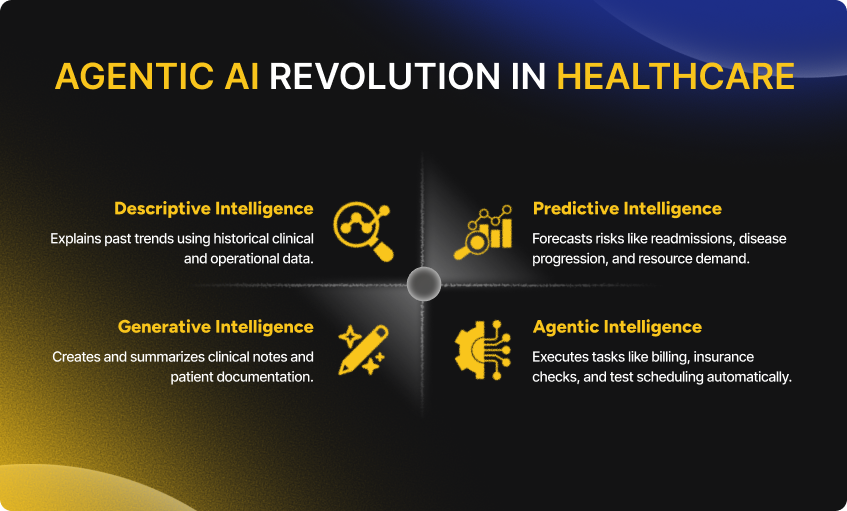
To understand how AI is used in healthcare today, you must recognize the evolution of the technology. For the last decade, AI in healthcare was synonymous with Machine Learning (ML), algorithms that analyzed data to predict outcomes (e.g., "This patient has a 20% risk of sepsis").
In 2026, we have entered the era of Agentic AI. These are autonomous agents capable of chaining complex tasks together without constant human hand-holding.
In 2026, we have entered the era of Agentic AI. These are autonomous agents capable of chaining complex tasks together without constant human hand-holding.
The Evolution of Medical AI
Wave 1: Descriptive AI (2015-2020): "What happened?" (e.g., Analyzing historical claims data).
Wave 2: Predictive AI (2020-2023): "What will happen?" (e.g., Predicting readmission risks).
Wave 3: Generative AI (2023-2025): "Create content." (e.g., Summarizing patient notes).
Wave 4: Agentic AI (2026+): "Do the work." (e.g., An agent listens to a consultation, codes the billing claim, checks insurance pre-authorization, and schedules the MRI).
Key Insight: Generative AI in healthcare is a "Librarian" that reads and writes. Agentic healthcare AI is a "Worker" that executes transactions. This shift is what allows hospitals to scale operations despite chronic staffing shortages.
Wave 2: Predictive AI (2020-2023): "What will happen?" (e.g., Predicting readmission risks).
Wave 3: Generative AI (2023-2025): "Create content." (e.g., Summarizing patient notes).
Wave 4: Agentic AI (2026+): "Do the work." (e.g., An agent listens to a consultation, codes the billing claim, checks insurance pre-authorization, and schedules the MRI).
Key Insight: Generative AI in healthcare is a "Librarian" that reads and writes. Agentic healthcare AI is a "Worker" that executes transactions. This shift is what allows hospitals to scale operations despite chronic staffing shortages.
Clinical Applications: Diagnostics, Surgery, and Monitoring
When exploring artificial intelligence examples in healthcare, the most visible impact is in the clinical setting. Here is a deep dive into how AI technology in healthcare is enhancing the "Standard of Care."
A. AI-Powered Medical Imaging (Radiology)
Radiologists are drowning in data. AI applications in healthcare imaging act as a "Second Reader," prioritizing scans based on urgency.
Stroke Detection: Time is brain. An Imperial College London study found that new AI software was twice as accurate as human specialists in determining stroke timing from brain scans. Tools like Viz.AI use similar algorithms to detect Large Vessel Occlusions (LVOs) in seconds, reducing time-to-treatment significantly.
Fracture Detection: Urgent care centers miss up to 10% of bone fractures due to human fatigue. New healthcare AI examples include models that overlay X-rays with "heatmaps," forcing the radiologist to double-check specific areas before signing off.
Cancer Screening: Google’s DeepMind has developed agents that scan mammograms. Their system reduced false positives in breast cancer screening by 5.7% and false negatives by 9.4%, demonstrating the clear benefits of AI in healthcare diagnostics.
Stroke Detection: Time is brain. An Imperial College London study found that new AI software was twice as accurate as human specialists in determining stroke timing from brain scans. Tools like Viz.AI use similar algorithms to detect Large Vessel Occlusions (LVOs) in seconds, reducing time-to-treatment significantly.
Fracture Detection: Urgent care centers miss up to 10% of bone fractures due to human fatigue. New healthcare AI examples include models that overlay X-rays with "heatmaps," forcing the radiologist to double-check specific areas before signing off.
Cancer Screening: Google’s DeepMind has developed agents that scan mammograms. Their system reduced false positives in breast cancer screening by 5.7% and false negatives by 9.4%, demonstrating the clear benefits of AI in healthcare diagnostics.
B. Robotic-Assisted Surgery
Artificial intelligence in healthcare is not just software; it is hardware.
Precision Control: Robots like the Da Vinci system use healthcare AI to filter out a surgeon's hand tremors. The AI scales large hand movements down to microscopic incisions, allowing for complex surgeries with minimal invasiveness.
Navigation: During spinal surgery, AI used in healthcare provides real-time 3D mapping of the patient’s anatomy (augmented reality). It guides the surgeon’s screws away from critical nerves, acting like a GPS for the human body.
Precision Control: Robots like the Da Vinci system use healthcare AI to filter out a surgeon's hand tremors. The AI scales large hand movements down to microscopic incisions, allowing for complex surgeries with minimal invasiveness.
Navigation: During spinal surgery, AI used in healthcare provides real-time 3D mapping of the patient’s anatomy (augmented reality). It guides the surgeon’s screws away from critical nerves, acting like a GPS for the human body.
C. The "Sepsis Sniffer" (Predictive Monitoring)
Sepsis is a silent killer in the ICU, often detected too late.
The Agent: Continuous monitoring agents analyze 20+ real-time signals (heart rate variability, lactate levels).
The Action: The artificial intelligence in the healthcare system alerts the nursing station 6-12 hours before clinical symptoms appear.
The Impact: Early antibiotic intervention reduces sepsis mortality rates by up to 20%. Johns Hopkins developed the TREWS (Targeted Real-Time Early Warning System), which has already saved hundreds of lives.
The Agent: Continuous monitoring agents analyze 20+ real-time signals (heart rate variability, lactate levels).
The Action: The artificial intelligence in the healthcare system alerts the nursing station 6-12 hours before clinical symptoms appear.
The Impact: Early antibiotic intervention reduces sepsis mortality rates by up to 20%. Johns Hopkins developed the TREWS (Targeted Real-Time Early Warning System), which has already saved hundreds of lives.
Administrative Applications: Solving the "Burnout" Crisis
While clinical healthcare AI grabs headlines, administrative AI drives the P&L. Benefits of AI in healthcare are most immediately realized in the back office.
A. Ambient Clinical Intelligence (The "Invisible" Scribe)
Physician burnout is driven by "Pajama Time," the hours doctors spend entering data into the EHR after work..
- The Solution: Ambient Intelligence (like Nuance DAX or Heidi Health) utilizes microphones to listen (with consent) to the consultation.
- The Workflow:
a. Listen: The AI system separates the doctor's voice from the patient's.
b. Transcribe: It converts audio to text.
c. Structure: It maps the text into the correct EHR fields (Subjective, Objective, Assessment, Plan).
- The ROI: These applications of generative AI in healthcare reduce documentation time from 15 minutes to <5 minutes per patient.
- The Solution: Ambient Intelligence (like Nuance DAX or Heidi Health) utilizes microphones to listen (with consent) to the consultation.
- The Workflow:
a. Listen: The AI system separates the doctor's voice from the patient's.
b. Transcribe: It converts audio to text.
c. Structure: It maps the text into the correct EHR fields (Subjective, Objective, Assessment, Plan).
- The ROI: These applications of generative AI in healthcare reduce documentation time from 15 minutes to <5 minutes per patient.
B. Revenue Cycle Management (RCM)
Hospitals lose billions annually to claim denials.
- Pre-Authorization: Agentic AI checks the patient's insurance plan against the proposed procedure codes. It predicts the likelihood of denial and suggests documentation improvements before submission.
- Coding Automation: AI technology in healthcare parses clinical notes and automatically assigns ICD-10 codes. A few companies also report that AI-assisted coding reduces first-pass denials by 65%.
- Pre-Authorization: Agentic AI checks the patient's insurance plan against the proposed procedure codes. It predicts the likelihood of denial and suggests documentation improvements before submission.
- Coding Automation: AI technology in healthcare parses clinical notes and automatically assigns ICD-10 codes. A few companies also report that AI-assisted coding reduces first-pass denials by 65%.
Pharmaceutical Applications: The New Era of Drug Discovery
How is AI used in healthcare beyond the hospital? It is revolutionizing Pharma. Developing a new drug traditionally takes 10+ years and costs $2.6 billion. AI systems are breaking this curve.
A. Generative Chemistry & In Silico Discovery
- Target Identification: Artificial intelligence in healthcare analyzes massive biological datasets to identify disease targets.
- Molecule Generation: Generative AI model designs novel molecular structures that can bind to that target.
- Real-World Example: Insilico Medicine used generative AI to identify a target for idiopathic pulmonary fibrosis. They moved from concept to preclinical trials in just 18 months (vs. the industry average of 4-6 years) at a cost of only $150,000.
- Molecule Generation: Generative AI model designs novel molecular structures that can bind to that target.
- Real-World Example: Insilico Medicine used generative AI to identify a target for idiopathic pulmonary fibrosis. They moved from concept to preclinical trials in just 18 months (vs. the industry average of 4-6 years) at a cost of only $150,000.
B. "Digital Twins" & Virtual Trials
Instead of testing dangerous drugs on humans immediately, we create a "Digital Twin."
- The Tech: Companies like Siemens Healthineers create biophysical models of human organs using healthcare AI.
- The ROI: Exscientia utilized this approach to bring an AI-designed drug to clinical trials in less than 12 months, proving the massive benefits of AI agent in healthcare R&D.
- The Tech: Companies like Siemens Healthineers create biophysical models of human organs using healthcare AI.
- The ROI: Exscientia utilized this approach to bring an AI-designed drug to clinical trials in less than 12 months, proving the massive benefits of AI agent in healthcare R&D.
The Business Case: ROI and Benefits of AI in Healthcare
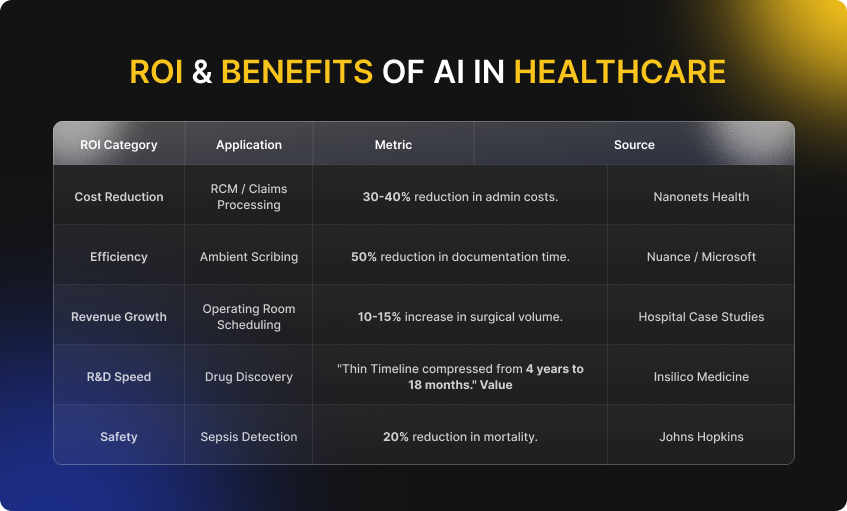
When selling AI model in healthcare internally, you need hard metrics. Here is the ROI breakdown for artificial intelligence in healthcare.
Architecture: Building Interoperable AI with FHIR
For Tech Leads & CTOs: Healthcare data is famously "siloed" in legacy systems like Epic, Cerner, and Meditech. You cannot simply "plug in" an AI model. You must architect a data orchestration layer.
The Interoperability Stack
To build custom healthcare AI, we utilize a 3-layer architecture:
1. The HL7/FHIR Bridge
We do not "screen scrape." We build API connectors that utilize Fast Healthcare Interoperability Resources (FHIR) standards.
Function: This allows your healthcare AI agent to read/write data to any major EHR in a structured, compliant format. It translates the AI's output into an HL7 message the hospital system understands.
2. The De-Identification Pipeline
Before data touches the AI technology in healthcare model, it must be stripped of PHI (Protected Health Information).
Function: We implement automated "scrubbers" that remove names, dates, SSNs, and MRNs. This ensures that even if the AI model is compromised, no patient data is exposed.
3. Vector Database (RAG)
To prevent hallucinations, we use Retrieval-Augmented Generation (RAG).
Function: When a doctor asks the AI model a question, it retrieves answers only from your verified internal medical protocols and textbooks—not from the open internet.
1. The HL7/FHIR Bridge
We do not "screen scrape." We build API connectors that utilize Fast Healthcare Interoperability Resources (FHIR) standards.
Function: This allows your healthcare AI agent to read/write data to any major EHR in a structured, compliant format. It translates the AI's output into an HL7 message the hospital system understands.
2. The De-Identification Pipeline
Before data touches the AI technology in healthcare model, it must be stripped of PHI (Protected Health Information).
Function: We implement automated "scrubbers" that remove names, dates, SSNs, and MRNs. This ensures that even if the AI model is compromised, no patient data is exposed.
3. Vector Database (RAG)
To prevent hallucinations, we use Retrieval-Augmented Generation (RAG).
Function: When a doctor asks the AI model a question, it retrieves answers only from your verified internal medical protocols and textbooks—not from the open internet.
Risk & Governance: The "Human-in-the-Loop" Protocol
In healthcare, an AI error is more than a glitch; it's a lawsuit. Governance must be engineered into the code.
As a development partner, we deploy Deterministic Guardrails to ensure safety for artificial intelligence model in healthcare.
The "Kill Switch" Pattern
- The Rule: Automated agents must have limits. If an AI diagnostic tool detects a "High Criticality" condition (e.g., Brain Bleed probability > 90%), it does not just log it.
- The Action: It triggers a "Circuit Breaker" that pages the on-call radiologist immediately and freezes any automated workflow.
Algorithmic Bias Audits
AI applied in healthcare is trained on historical data and can inherit biases.
- The Mitigation: We implement "Algorithmic Audits" where models are tested against diverse demographic datasets before deployment to ensure fair use of AI in healthcare.
Regulatory Compliance (EU AI Act & FDA)
- EU AI Act: Categorizes most artificial intelligence model in healthcare as "High Risk," requiring rigorous data governance and transparency logs.
- FDA SaMD: Software as a Medical Device requires "Explainability." You cannot use a "Black Box" model; you must be able to show why the healthcare AI made a recommendation.
As a development partner, we deploy Deterministic Guardrails to ensure safety for artificial intelligence model in healthcare.
The "Kill Switch" Pattern
- The Rule: Automated agents must have limits. If an AI diagnostic tool detects a "High Criticality" condition (e.g., Brain Bleed probability > 90%), it does not just log it.
- The Action: It triggers a "Circuit Breaker" that pages the on-call radiologist immediately and freezes any automated workflow.
Algorithmic Bias Audits
AI applied in healthcare is trained on historical data and can inherit biases.
- The Mitigation: We implement "Algorithmic Audits" where models are tested against diverse demographic datasets before deployment to ensure fair use of AI in healthcare.
Regulatory Compliance (EU AI Act & FDA)
- EU AI Act: Categorizes most artificial intelligence model in healthcare as "High Risk," requiring rigorous data governance and transparency logs.
- FDA SaMD: Software as a Medical Device requires "Explainability." You cannot use a "Black Box" model; you must be able to show why the healthcare AI made a recommendation.
Strategic Asset Ownership: Build vs. Buy in MedTech
Should you buy a SaaS tool or build your own AI?
For simple admin tasks, buying SaaS is fine. But for core competitive advantage, Custom Development wins.
For simple admin tasks, buying SaaS is fine. But for core competitive advantage, Custom Development wins.
The Case for "Building"
1. Data Sovereignty: When you use a public SaaS, you are often training their model. When you build custom healthcare AI, you own the IP and the trained weights.
2. Workflow Integration: Off-the-shelf tools rarely fit perfectly into complex hospital workflows. Custom AI agents for healthcare are built to fit your specific clinical pathways.
3. Valuation: Proprietary AI technology in healthcare assets increase the valuation of your MedTech company. Renting API access does not.
2. Workflow Integration: Off-the-shelf tools rarely fit perfectly into complex hospital workflows. Custom AI agents for healthcare are built to fit your specific clinical pathways.
3. Valuation: Proprietary AI technology in healthcare assets increase the valuation of your MedTech company. Renting API access does not.
Future Trends: What to Watch in 2026
The adoption of how AI is used in healthcare continues to evolve. Here is what is coming next.
- Multimodal AI (Holomics): Artificial intelligence examples in healthcare that don't just look at one data point. They ingest text (notes), images (CT scans), and genomics (DNA) simultaneously.
- Hospital at Home: Wearable sensors (Ambient Sensing) allow patients to recover at home while AI monitors their vitals 24/7.
- AI at the Edge: Moving healthcare AI processing from the cloud to the device (e.g., the MRI machine itself). This allows for zero-latency analysis, critical for emergency surgery.
- Multimodal AI (Holomics): Artificial intelligence examples in healthcare that don't just look at one data point. They ingest text (notes), images (CT scans), and genomics (DNA) simultaneously.
- Hospital at Home: Wearable sensors (Ambient Sensing) allow patients to recover at home while AI monitors their vitals 24/7.
- AI at the Edge: Moving healthcare AI processing from the cloud to the device (e.g., the MRI machine itself). This allows for zero-latency analysis, critical for emergency surgery.
FAQ: Common Questions on Medical AI
1. How is AI used in healthcare today vs. 5 years ago?
Five years ago, AI models in healthcare were largely experimental research. Today, AI used in healthcare is operational: powering live chatbots, automated coding systems, and real-time sepsis alerts in ICUs globally.
2. What are the main benefits of AI in healthcare for administrators?
The primary benefits of AI agent in healthcare for admins are cost reduction and capacity management. Healthcare AI predicts patient inflow to optimize staffing and automates the manual coding of insurance claims, reducing denial rates.
3. Is Generative AI in healthcare safe?
Yes, but only when "grounded." We use RAG (Retrieval-Augmented Generation) to ensure the generative AI in healthcare only generates answers based on verified medical literature, preventing "hallucinations."
4. Can AI replace doctors?
No. Artificial intelligence in healthcare is an "Augmented Intelligence" tool. It handles data analysis and administrative drudgery, allowing doctors to focus on complex reasoning, empathy, and patient care.

Written by / Author
Manasi Maheshwari
Found this useful? Share With
Top blogs
Most Read Blogs
Wits Innovation Lab is where creativity and innovation flourish. We provide the tools you need to come up with innovative solutions for today's businesses, big or small.
© 2026 Wits Innovation Lab, All rights reserved
Crafted in-house by WIL’s talented minds