

The shift from AI as a coding assistant to AI as an autonomous engineering participant is no longer speculative. In 2026, AI agentic workflows are running production workloads where multiple AI coding agents collaborate, self-check, and ship code with minimal human input at each step. This guide covers how agentic AI development actually works, where it is being used, what the Model Context Protocol MCP means for your tech stack, and the real tradeoffs teams are navigating right now.
What makes a workflow "agentic" and why it matters
The word "agentic" has accumulated a lot of noise, so it helps to be precise. A standard LLM interaction is stateless and reactive: you send a prompt, you receive a completion. An agentic AI development system is one where the model can plan a sequence of steps, call external tools at each step, observe the result, and decide what to do next, all within a single task, without a human prompt at each decision point.
The practical consequence is that tasks with multiple dependent sub-steps can now be delegated entirely. "Analyse the failing tests, identify the root cause, write a fix, run the tests again, and open a pull request" becomes a single instruction. What distinguishes AI agentic workflows from the automation pipelines of the past five years is that the agent handles ambiguity. It reads error messages, adapts its plan, and retries. It does not require every edge case to be anticipated at design time.
A meaningful benchmark for this shift: leading AI coding agents now score above 80% on SWE-bench Verified, a dataset of real-world GitHub issues requiring diagnosis, code changes, and validation. Two years ago, the best scores were in the low 20s.
This is not an argument that human engineers are replaceable. It is an argument that the unit of engineering work is changing. The decisions that require architectural judgment, business context, and creative problem-solving stay with humans. The execution of well-scoped, verifiable tasks, clearing technical debt, migrating dependencies, writing test coverage for existing functions, is increasingly delegated to autonomous coding AI. Teams that have integrated this well describe it as cognitive leverage: the ability to operate at a higher level of abstraction for longer periods, with less context-switching into routine implementation work.
The practical consequence is that tasks with multiple dependent sub-steps can now be delegated entirely. "Analyse the failing tests, identify the root cause, write a fix, run the tests again, and open a pull request" becomes a single instruction. What distinguishes AI agentic workflows from the automation pipelines of the past five years is that the agent handles ambiguity. It reads error messages, adapts its plan, and retries. It does not require every edge case to be anticipated at design time.
A meaningful benchmark for this shift: leading AI coding agents now score above 80% on SWE-bench Verified, a dataset of real-world GitHub issues requiring diagnosis, code changes, and validation. Two years ago, the best scores were in the low 20s.
This is not an argument that human engineers are replaceable. It is an argument that the unit of engineering work is changing. The decisions that require architectural judgment, business context, and creative problem-solving stay with humans. The execution of well-scoped, verifiable tasks, clearing technical debt, migrating dependencies, writing test coverage for existing functions, is increasingly delegated to autonomous coding AI. Teams that have integrated this well describe it as cognitive leverage: the ability to operate at a higher level of abstraction for longer periods, with less context-switching into routine implementation work.
Single-agent vs. multi-agent systems
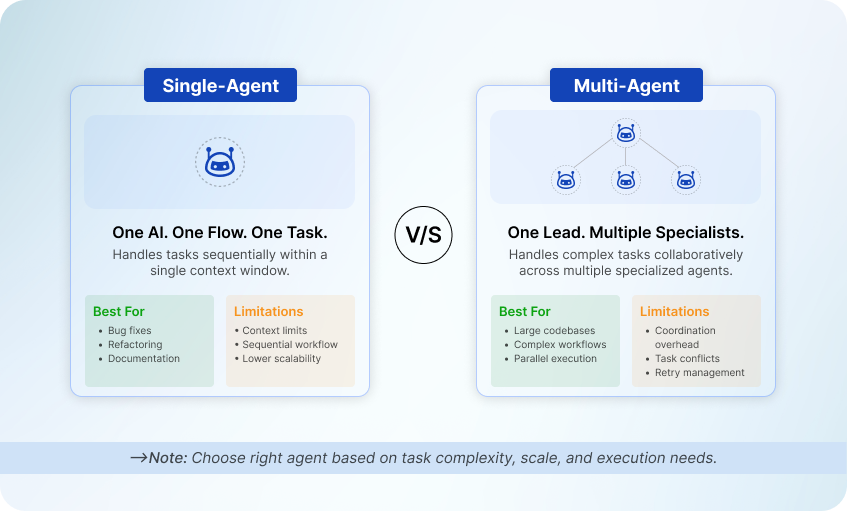
Most production deployments in 2025 were single-agent: one model, one context window, one task at a time. That model suffices for a large range of tasks, a self-contained refactor, a bug fix with clear reproduction steps, and a documentation pass. The constraint is context length and specialisation. Complex tasks that require holding an entire large codebase in context, running tests in parallel, or calling on domain-specific expertise hit the ceiling of a single context window.
Multi-agent systems solve this with a coordinator-worker model. A directing agent receives a high-level task, breaks it down, and dispatches sub-tasks to specialised AI coding agents running in parallel, each with its own context window, each scoped to a domain. Results flow back to the directing agent, which synthesises them and determines the next step.
The key design decisions in a multi-agent system:
Task decomposition strategy. How granular should sub-tasks be? Finer decomposition allows more parallelism but increases coordination overhead and the surface area for errors to compound.
Handoff protocol. How does one agent's output become the next agent's input in a structured, verifiable way? Poorly specified handoffs are the most common source of failure in multi-agent systems.
Context isolation. Agents working in parallel on the same codebase must operate on isolated branches or file scopes. Without isolation, conflicting writes corrupt state in ways that are difficult to debug.
Failure handling. What happens when a sub-agent returns a low-confidence result or times out? Production-grade systems need explicit retry semantics and escalation paths, not just error logging.
Observability. Every action an agent takes, tool calls, decisions, outputs, must be traceable. You cannot debug AI agentic workflows you cannot observe.
The primary technical challenge in multi-agent systems is not getting the agents to run. Frameworks like LangGraph and AutoGen handle the boilerplate. The challenge is designing the handoff contracts between agents precisely enough that the system behaves reliably across the full distribution of real inputs, not just the happy path.
Multi-agent systems solve this with a coordinator-worker model. A directing agent receives a high-level task, breaks it down, and dispatches sub-tasks to specialised AI coding agents running in parallel, each with its own context window, each scoped to a domain. Results flow back to the directing agent, which synthesises them and determines the next step.
The key design decisions in a multi-agent system:
Task decomposition strategy. How granular should sub-tasks be? Finer decomposition allows more parallelism but increases coordination overhead and the surface area for errors to compound.
Handoff protocol. How does one agent's output become the next agent's input in a structured, verifiable way? Poorly specified handoffs are the most common source of failure in multi-agent systems.
Context isolation. Agents working in parallel on the same codebase must operate on isolated branches or file scopes. Without isolation, conflicting writes corrupt state in ways that are difficult to debug.
Failure handling. What happens when a sub-agent returns a low-confidence result or times out? Production-grade systems need explicit retry semantics and escalation paths, not just error logging.
Observability. Every action an agent takes, tool calls, decisions, outputs, must be traceable. You cannot debug AI agentic workflows you cannot observe.
The primary technical challenge in multi-agent systems is not getting the agents to run. Frameworks like LangGraph and AutoGen handle the boilerplate. The challenge is designing the handoff contracts between agents precisely enough that the system behaves reliably across the full distribution of real inputs, not just the happy path.
Model Context Protocol MCP: the integration layer holding it together
For an agent to do useful work in a real engineering environment, it needs access to real systems: the codebase, the issue tracker, the database, the CI pipeline, the deployment platform. Before 2025, connecting an AI model to each of these systems meant building custom integration code for every combination, a maintenance burden that grew quadratically with the number of tools.
The Model Context Protocol MCP addresses this directly. Released by Anthropic in November 2024 and now governed under the Linux Foundation, MCP is an open standard that defines a uniform communication interface between an AI coding agent and external tools. Instead of custom connectors, you write or deploy an MCP server for each tool once, and any MCP-compatible model can use it. The architecture uses JSON-RPC 2.0 over two transport layers: stdio for local processes and HTTP with Server-Sent Events for remote production deployments.
Adoption has been unusually fast. Model Context Protocol MCP SDK downloads reached 97 million per month as of March 2026. There are now over 5,800 community MCP servers available. OpenAI and Google both adopted the standard in 2025, which resolved what had been a fragmentation problem. Tool integrations built for one model's format now work across any compliant model, regardless of vendor. For most organisations, integration work for standard business tools is already done. Production-ready MCP servers exist for GitHub, Google Drive, PostgreSQL, Slack, Jira, AWS, Stripe, Supabase, and hundreds of others.
What MCP enables in a web development context:
- An AI coding agent reads a Jira ticket, pulls the relevant file from GitHub, writes a fix, runs the test suite via a CI API call, and opens a pull request, all within one task, with no human step in between.
- A database agent receives a natural-language query, constructs and executes a PostgreSQL query via the database MCP server, and returns a formatted result.
- A support agent reviews a ticket history, retrieves internal documentation, checks an order status, and either resolves the ticket or escalates it, with a structured audit trail of every action taken.
The Model Context Protocol MCP 2026 roadmap focuses on three gaps that production use has exposed: stateless horizontal scaling, enterprise authentication via OAuth 2.1 and SAML/OIDC, and a verified server registry with security ratings. Each addresses real blockers for regulated-industry deployment.
Security note: Researchers have verified meaningful risks in MCP deployments, including prompt injection through tool responses, permission combinations that allow unintended data access, and lookalike servers that impersonate trusted ones. Every MCP deployment should apply minimum-permission principles, strict read/write separation, and comprehensive logging of all agent actions before touching sensitive systems.
The Model Context Protocol MCP addresses this directly. Released by Anthropic in November 2024 and now governed under the Linux Foundation, MCP is an open standard that defines a uniform communication interface between an AI coding agent and external tools. Instead of custom connectors, you write or deploy an MCP server for each tool once, and any MCP-compatible model can use it. The architecture uses JSON-RPC 2.0 over two transport layers: stdio for local processes and HTTP with Server-Sent Events for remote production deployments.
Adoption has been unusually fast. Model Context Protocol MCP SDK downloads reached 97 million per month as of March 2026. There are now over 5,800 community MCP servers available. OpenAI and Google both adopted the standard in 2025, which resolved what had been a fragmentation problem. Tool integrations built for one model's format now work across any compliant model, regardless of vendor. For most organisations, integration work for standard business tools is already done. Production-ready MCP servers exist for GitHub, Google Drive, PostgreSQL, Slack, Jira, AWS, Stripe, Supabase, and hundreds of others.
What MCP enables in a web development context:
- An AI coding agent reads a Jira ticket, pulls the relevant file from GitHub, writes a fix, runs the test suite via a CI API call, and opens a pull request, all within one task, with no human step in between.
- A database agent receives a natural-language query, constructs and executes a PostgreSQL query via the database MCP server, and returns a formatted result.
- A support agent reviews a ticket history, retrieves internal documentation, checks an order status, and either resolves the ticket or escalates it, with a structured audit trail of every action taken.
The Model Context Protocol MCP 2026 roadmap focuses on three gaps that production use has exposed: stateless horizontal scaling, enterprise authentication via OAuth 2.1 and SAML/OIDC, and a verified server registry with security ratings. Each addresses real blockers for regulated-industry deployment.
Security note: Researchers have verified meaningful risks in MCP deployments, including prompt injection through tool responses, permission combinations that allow unintended data access, and lookalike servers that impersonate trusted ones. Every MCP deployment should apply minimum-permission principles, strict read/write separation, and comprehensive logging of all agent actions before touching sensitive systems.
The four AI agentic workflow patterns in production
Most production agentic AI development systems fall into one of four architectural patterns. Knowing which pattern fits a use case determines how to scope the agents, design the prompts, and handle failure.
- Sequential Chain. The output of one agent becomes the input of the next. Simple to reason about, easy to test. Works well when each step has a clear output contract. Brittle when an early step produces low-quality output that compounds downstream.
- Parallel Fan-Out. A directing agent dispatches multiple AI coding agents simultaneously to work on independent sub-problems, then aggregates results. Requires isolated working environments and explicit conflict resolution logic at the synthesis step.
- Reflection Loop. An agent generates output, a second agent critiques it against defined criteria, and the generator revises. Effective for code quality and security review steps within agentic AI development pipelines. Adds latency proportional to revision depth.
- Human-in-the-Loop. The autonomous coding AI proceeds up to a defined confidence threshold or risk level, then pauses and surfaces a decision for human review before continuing. The right default for any action touching production systems or sensitive data.
The principle that consistently produces reliable multi-agent systems: give the agent the minimum autonomy required to complete the task. Every additional degree of freedom increases the space of ways things can go wrong. Start with human-in-the-loop and expand autonomy only where the task is well-understood, the outputs are easily verifiable, and the failure mode is recoverable.
- Sequential Chain. The output of one agent becomes the input of the next. Simple to reason about, easy to test. Works well when each step has a clear output contract. Brittle when an early step produces low-quality output that compounds downstream.
- Parallel Fan-Out. A directing agent dispatches multiple AI coding agents simultaneously to work on independent sub-problems, then aggregates results. Requires isolated working environments and explicit conflict resolution logic at the synthesis step.
- Reflection Loop. An agent generates output, a second agent critiques it against defined criteria, and the generator revises. Effective for code quality and security review steps within agentic AI development pipelines. Adds latency proportional to revision depth.
- Human-in-the-Loop. The autonomous coding AI proceeds up to a defined confidence threshold or risk level, then pauses and surfaces a decision for human review before continuing. The right default for any action touching production systems or sensitive data.
The principle that consistently produces reliable multi-agent systems: give the agent the minimum autonomy required to complete the task. Every additional degree of freedom increases the space of ways things can go wrong. Start with human-in-the-loop and expand autonomy only where the task is well-understood, the outputs are easily verifiable, and the failure mode is recoverable.
The current AI developer tools situation (2026)
The AI developer tools market in 2026 has consolidated around a small set of options seeing serious production use, alongside a long tail of experiment-stage projects.
- Claude Code works best for deep reasoning, architectural changes, and complex debugging. Terminal-native with full filesystem and git access. Strongest on conceptually difficult tasks within agentic AI development workflows.
- Cursor fits daily coding, small-to-medium features, multi-file context, refactoring, and test generation. The most widely adopted IDE-integrated AI coding agent.
- GitHub Copilot Agent Mode suits CI/CD integration and pull request automation. Tight VS Code and GitHub integration, best for teams already on the GitHub ecosystem.
- Devin by Cognition handles technical debt, legacy migrations, and dependency upgrades. Can browse documentation, debug its own environment, and interface with APIs as a fully autonomous coding AI.
- BMAD and similar agent runners work well for multi-agent systems with structured, sprint-like execution. Pairs well with Figma MCP for design-to-code pipelines.
One thing the AI developer tools landscape makes clear: the choice of model matters less than the design of the system around it. Teams that chase the newest frontier model are generally outperformed by teams that pick one AI coding agent per role, instrument it well, and invest in improving their tool definitions and context management.
- Claude Code works best for deep reasoning, architectural changes, and complex debugging. Terminal-native with full filesystem and git access. Strongest on conceptually difficult tasks within agentic AI development workflows.
- Cursor fits daily coding, small-to-medium features, multi-file context, refactoring, and test generation. The most widely adopted IDE-integrated AI coding agent.
- GitHub Copilot Agent Mode suits CI/CD integration and pull request automation. Tight VS Code and GitHub integration, best for teams already on the GitHub ecosystem.
- Devin by Cognition handles technical debt, legacy migrations, and dependency upgrades. Can browse documentation, debug its own environment, and interface with APIs as a fully autonomous coding AI.
- BMAD and similar agent runners work well for multi-agent systems with structured, sprint-like execution. Pairs well with Figma MCP for design-to-code pipelines.
One thing the AI developer tools landscape makes clear: the choice of model matters less than the design of the system around it. Teams that chase the newest frontier model are generally outperformed by teams that pick one AI coding agent per role, instrument it well, and invest in improving their tool definitions and context management.
Security, governance, and the attack surface problem
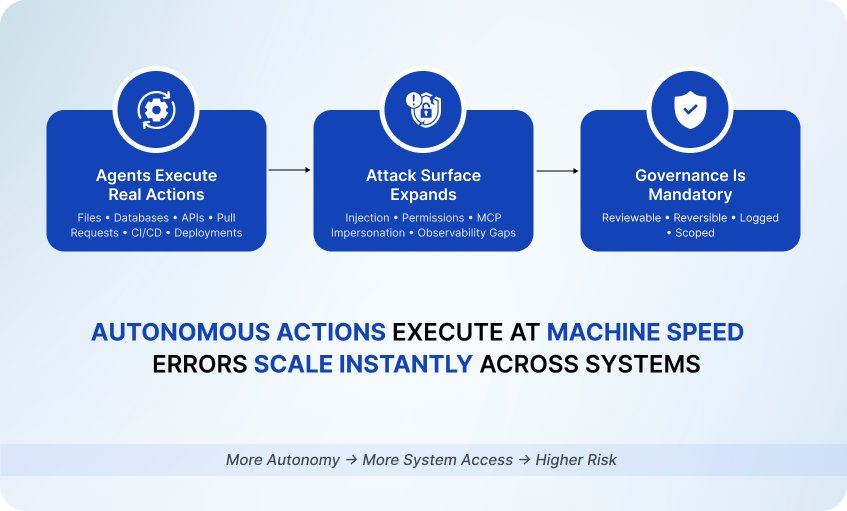
AI agentic workflows expand the attack surface of a software project in ways that most security reviews have not yet caught up with. When an autonomous coding AI can read files, query databases, call APIs, and open pull requests, a successful prompt injection, whether from a malicious ticket description, a poisoned code comment, or a rogue MCP server, can trigger real system actions at machine speed.
The security concerns verified in real agentic AI development deployments:
1. Prompt injection via tool results. An agent that reads data from an external system can have its behaviour hijacked by malicious instructions embedded in that data. Unlike web XSS, the payload is natural language, which makes it much harder to sanitise with traditional methods.
2. Overpermissioned tool access. An AI coding agent given write access to a database for one purpose will use that access for any purpose it determines is relevant. Permissions should be scoped to the specific operations the task requires, never to the full capability of the underlying system.
3. Lookalike MCP servers. A malicious or misconfigured server impersonating a trusted Model Context Protocol MCP tool can intercept agent actions or redirect them. Verified server registries and hash-pinned server definitions are the mitigation.
4. Observability gaps. Activity from multi-agent systems occurring within rendering layers or through MCP calls is often invisible to standard security inspection tools, creating compliance blind spots in regulated environments.
The governance posture for 2026: treat every agent action as if a junior developer executed it. It needs to be reviewable, reversible, and logged. Checkpointing, structured state, and clear permission boundaries are not optional instrumentation. They are the foundation that makes AI agentic workflows trustworthy enough to expand over time.
The security concerns verified in real agentic AI development deployments:
1. Prompt injection via tool results. An agent that reads data from an external system can have its behaviour hijacked by malicious instructions embedded in that data. Unlike web XSS, the payload is natural language, which makes it much harder to sanitise with traditional methods.
2. Overpermissioned tool access. An AI coding agent given write access to a database for one purpose will use that access for any purpose it determines is relevant. Permissions should be scoped to the specific operations the task requires, never to the full capability of the underlying system.
3. Lookalike MCP servers. A malicious or misconfigured server impersonating a trusted Model Context Protocol MCP tool can intercept agent actions or redirect them. Verified server registries and hash-pinned server definitions are the mitigation.
4. Observability gaps. Activity from multi-agent systems occurring within rendering layers or through MCP calls is often invisible to standard security inspection tools, creating compliance blind spots in regulated environments.
The governance posture for 2026: treat every agent action as if a junior developer executed it. It needs to be reviewable, reversible, and logged. Checkpointing, structured state, and clear permission boundaries are not optional instrumentation. They are the foundation that makes AI agentic workflows trustworthy enough to expand over time.
What this means for engineering teams
The productivity data is significant enough to change how engineering capacity gets planned. Organisations that have restructured around agentic AI development report 20 to 40 percent reductions in operating costs on AI-suitable workloads, with faster delivery cycles. The mechanism is not that you need fewer engineers. It is that the engineers you have can handle more scope without the ramp-up time typically required when entering an unfamiliar part of a codebase.
The skill set shift is real. The most valuable capability in a team working with AI agentic workflows is not writing code faster. It is the ability to:
- Break down complex problems into well-scoped, verifiable sub-tasks that AI coding agents can execute reliably
Design tool interfaces and API contracts that give autonomous coding AI enough context to act correctly without exposing unnecessary surface area.
- Read and evaluate agent-generated code critically, assessing not just whether it works but whether it maintains the integrity of the system.
- Build observability infrastructure that makes multi-agent systems auditable and debuggable.
- Know which tasks to delegate and which to keep, specifically the design-dependent, high-stakes decisions that require genuine judgment.
Teams that struggle with AI agentic workflows typically have one of two problems: they are delegating tasks that are underspecified, or they are not verifying outputs before they compound. Both are solvable with engineering discipline, not better models.
The skill set shift is real. The most valuable capability in a team working with AI agentic workflows is not writing code faster. It is the ability to:
- Break down complex problems into well-scoped, verifiable sub-tasks that AI coding agents can execute reliably
Design tool interfaces and API contracts that give autonomous coding AI enough context to act correctly without exposing unnecessary surface area.
- Read and evaluate agent-generated code critically, assessing not just whether it works but whether it maintains the integrity of the system.
- Build observability infrastructure that makes multi-agent systems auditable and debuggable.
- Know which tasks to delegate and which to keep, specifically the design-dependent, high-stakes decisions that require genuine judgment.
Teams that struggle with AI agentic workflows typically have one of two problems: they are delegating tasks that are underspecified, or they are not verifying outputs before they compound. Both are solvable with engineering discipline, not better models.
Practical starting points
Match the architecture to the use case, give the system the minimum autonomy that delivers the outcome, and build toward more autonomy only as you accumulate trust in specific task types.
1. Start with lower-risk tasks. Technical debt clearance, dependency upgrades, test coverage expansion. These are high-value, easily verifiable, and low-stakes if an AI coding agent produces a bad result, because a CI run catches it before it ships.
2. Instrument before you automate. Before expanding autonomy in any AI agentic workflow, ensure every action is logged in a structured format your team can query. You cannot improve what you cannot see.
3. Define your Model Context Protocol MCP surface deliberately. Do not expose the full capability of any system through an MCP server. Define tools that represent specific, governed actions and name them precisely enough that a model can select the right one without guessing.
4. Build a small evaluation set early. For each agent task type, collect 10 to 20 examples of inputs and expected outputs. Run the autonomous coding AI against them when you change models, prompts, or tools. This is the only reliable way to catch regressions before users do.
5. Keep the human in the loop on anything irreversible. Database writes, production deployments, and external API calls that trigger billing or communication. These should require a human confirmation step until you have strong evidence of reliable behaviour across those exact actions.
The engineering teams extracting the most value from AI agentic workflows in 2026 are not the ones using the newest or most powerful models. They are the ones that have built clean tool boundaries, explicit permission structures, strong tracing, and a small but reliable evaluation suite before expanding automation to the next task type. That infrastructure survives model changes. And it makes every upgrade less risky and less work.
1. Start with lower-risk tasks. Technical debt clearance, dependency upgrades, test coverage expansion. These are high-value, easily verifiable, and low-stakes if an AI coding agent produces a bad result, because a CI run catches it before it ships.
2. Instrument before you automate. Before expanding autonomy in any AI agentic workflow, ensure every action is logged in a structured format your team can query. You cannot improve what you cannot see.
3. Define your Model Context Protocol MCP surface deliberately. Do not expose the full capability of any system through an MCP server. Define tools that represent specific, governed actions and name them precisely enough that a model can select the right one without guessing.
4. Build a small evaluation set early. For each agent task type, collect 10 to 20 examples of inputs and expected outputs. Run the autonomous coding AI against them when you change models, prompts, or tools. This is the only reliable way to catch regressions before users do.
5. Keep the human in the loop on anything irreversible. Database writes, production deployments, and external API calls that trigger billing or communication. These should require a human confirmation step until you have strong evidence of reliable behaviour across those exact actions.
The engineering teams extracting the most value from AI agentic workflows in 2026 are not the ones using the newest or most powerful models. They are the ones that have built clean tool boundaries, explicit permission structures, strong tracing, and a small but reliable evaluation suite before expanding automation to the next task type. That infrastructure survives model changes. And it makes every upgrade less risky and less work.

Written by / Author
Manasi Maheshwari
Found this useful? Share With
Top blogs
Most Read Blogs
Wits Innovation Lab is where creativity and innovation flourish. We provide the tools you need to come up with innovative solutions for today's businesses, big or small.
© 2026 Wits Innovation Lab, All rights reserved
Crafted in-house by WIL’s talented minds